Ad Blocker Detected
Our website is made possible by displaying online advertisements to our visitors. Please consider supporting us by disabling your ad blocker.
When selecting a power station, we recognize the importance of understanding the distinctions between budget and premium models. These differences impact performance, safety, and long-term value, making the choice complex yet critical. By analyzing core features and application needs, we can better determine which option aligns with specific energy demands. This evaluation can substantially influence reliability and cost-effectiveness, prompting us to contemplate key factors before making a final decision.
Key Takeaways
- Budget power stations offer basic features, lower capacity, and simpler battery chemistries, suitable for short-term, low-demand use.
- Premium units provide higher capacity, advanced battery technologies, and enhanced system integration for longer, more reliable operation.
- Cost differences reflect build quality, durability, safety features, and performance, with premium models generally costing more upfront.
- Budget models are ideal for outdoor trips, small backups, and temporary power needs; premium stations support renewable energy and industrial applications.
- Long-term value favors premium stations due to better efficiency, durability, and lower maintenance, despite higher initial investment.
How Do Budget and Premium Power Stations Differ in Core Features?
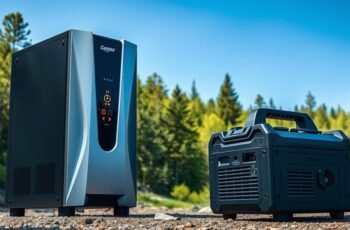
While budget and premium power stations share the fundamental purpose of providing portable energy, they differ markedly in their core features. Budget models typically incorporate basic energy storage systems with limited capacity, often relying on simpler battery chemistries that impact longevity and efficiency. Power management in these units tends to be straightforward, offering minimal control or customization. Conversely, premium power stations feature advanced energy storage solutions with higher capacity, improved cycle life, and optimized chemistries for durability. Their sophisticated power management systems enable precise regulation of output, multiple device charging options, and real-time monitoring. These enhancements result in greater reliability, efficiency, and flexibility, making premium units suitable for demanding applications. Ultimately, their core differences revolve around how effectively they manage energy storage and control power flow.
What Are the Key Benefits of Choosing a Budget Power Station?
Choosing a budget power station offers a cost-effective solution for essential power needs without sacrificing reliability. Their lightweight design enhances portability and simplifies operation, making them suitable for on-the-go applications. These units are ideal for users with basic requirements, providing efficient power without unnecessary features.
Cost-Effective Power Solution
Budget power stations offer a highly cost-effective solution for users seeking reliable energy without exceeding their financial limits. Their affordability allows for widespread deployment, supporting renewable integration initiatives by providing stable backup power during intermittent renewable sources. This enhances the resilience of the local power grid, reducing dependency on centralized infrastructure. Additionally, budget models typically incorporate essential features such as inverter technology and efficient energy management, optimizing power output and reducing operational costs. Their straightforward design minimizes maintenance expenses and simplifies integration with existing systems. By delivering dependable performance at a lower upfront investment, these stations enable organizations and individuals to expand energy access, promote sustainable practices, and strengthen grid stability without incurring excessive costs.
Easy Portability and Use
The lightweight and compact design of budget power stations considerably enhances their portability, making them ideal for a wide range of applications, from outdoor activities to emergency backup. This design facilitates easy transport, reducing physical strain and enabling quick deployment in various scenarios. Their energy efficiency often stems from simplified circuitry and fewer features, which minimizes power consumption during operation. This efficiency not only conserves battery life but also reduces environmental impact by lowering emissions associated with energy use. The reduced size and weight contribute to lower manufacturing and transportation footprints, further benefiting the environment. Consequently, budget power stations offer a practical balance of portability and energy-conscious operation, making them suitable for users prioritizing convenience and sustainability without the complexity of premium models.
Suitable for Basic Needs
For those with basic power needs, a budget power station delivers essential functionality without unnecessary features that could complicate operation or inflate costs. These units prioritize energy efficiency, ensuring reliable power output while minimizing energy loss, which is vital for cost-effective operation. They typically come from brands with established reputations for durability and consistent performance, providing confidence in their longevity and reliability. While they may lack advanced features, their straightforward design simplifies usage, making them ideal for simple tasks like camping, small-scale backup, or outdoor activities. This focus on core performance ensures users can meet essential power requirements efficiently, without overpaying for premium features that may not be necessary for basic applications.
Why Invest in a Premium Power Station? Benefits and Justifications
Investing in a premium power station offers notable advantages in durability and reliability, reducing downtime and maintenance costs over its lifespan. Its superior performance and efficiency translate to more stable power output and optimized energy use. These technical benefits justify higher initial costs by ensuring long-term operational excellence.
Enhanced Durability and Reliability
While budget power stations may suffice for basic needs, premium models deliver markedly enhanced durability and reliability thanks to higher-grade components and rigorous manufacturing standards. This results in superior energy efficiency, reducing ongoing operating costs and minimizing environmental impact. The robustness of premium units means consistent performance under demanding conditions, decreasing failure rates and maintenance needs. Their advanced construction ensures longer lifespan, providing a reliable power source over time. This reliability is critical during emergencies, where failure could have serious consequences. Investing in a premium power station offers peace of mind, knowing it’s built for resilience and efficiency.
| Feature | Impact on Durability | Environmental Benefit |
|---|---|---|
| High-grade components | Longer lifespan, fewer repairs | Reduced waste, energy use |
| Rigorous manufacturing | Consistent performance | Lower environmental impact |
| Advanced heat dissipation | Prevents overheating | Energy-efficient operation |
| Superior build quality | Greater resilience | Sustainable resource use |
Superior Performance and Efficiency
Premium power stations deliver superior performance and efficiency due to advanced engineering and high-quality components. These units optimize renewable integration, seamlessly managing intermittent energy sources like solar and wind, which enhances overall system stability. Their precise control systems minimize noise levels, reducing operational disruptions and environmental impact. The use of superior inverters and cooling mechanisms ensures consistent power output, even under variable loads, maximizing efficiency. Additionally, premium models incorporate sophisticated energy management features, improving overall system responsiveness and reducing waste. This technical robustness translates into higher reliability, lower maintenance costs, and greater adaptability for diverse applications. Investing in a premium power station guarantees optimized performance, making it a strategic choice for those prioritizing efficiency, renewable compatibility, and environmental considerations.
How Do Price and Performance Impact Durability and Longevity?
Price and performance are essential factors influencing the durability and longevity of power stations, as higher-quality components often correlate with increased resilience under demanding conditions. Price considerations directly impact the selection of materials and build quality, with premium units typically utilizing superior components that reduce wear and failure rates over time. Performance metrics, such as thermal management and electrical stability, also play a crucial role; stations optimized for high performance tend to operate more efficiently and withstand stress better. Conversely, budget models may compromise on these aspects, resulting in reduced lifespan and increased maintenance. Ultimately, investing in higher-performance power stations can yield long-term benefits by ensuring sustained reliability and durability, making them better suited for demanding or continuous use scenarios.
Which Use Cases Are Best Suited for Budget Power Stations?
Budget power stations are well-suited for applications requiring reliable emergency backup, where cost-effective solutions provide essential power continuity. They also excel during outdoor adventure trips, offering portable, lightweight energy sources for critical devices. Additionally, their use on small-scale construction sites enables temporary power without the higher investment of premium units.
Emergency Power Backup
Have you considered which emergency power backup scenarios are most suitable for budget power stations? These units are generally effective for short-duration outages, such as brief grid failures or localized disruptions. They are suitable for essential devices with low power demands, including communication equipment or small LED lighting. While budget stations often lack advanced features like renewable integration, they can still provide reliable backup for critical electronics. However, their battery lifespan tends to be shorter, requiring more frequent replacements, which can impact long-term sustainability. For applications demanding quick, temporary power without extensive maintenance, they are a cost-effective solution. Nonetheless, for prolonged outages or complex energy needs, premium stations with better battery technology and renewable integration may be more appropriate.
Outdoor Adventure Trips
When selecting power solutions for outdoor adventure trips, understanding the operational scope and energy demands is essential. Budget power stations are well-suited for these trips due to their simplicity and portability, especially when integrated with solar panels for renewable energy input. They efficiently support low to moderate power requirements such as charging devices, small appliances, and LED lighting. Additionally, budget units typically feature lower noise levels, which minimizes disturbance in natural settings. While they lack advanced features like extensive solar integration or high-capacity outputs, their reliability for short-term, low-demand use remains advantageous. These stations are ideal for maintaining essential power without compromising on portability or environmental considerations, making them suitable for hikers, campers, and outdoor enthusiasts seeking cost-effective, quiet solutions.
Small-Scale Construction Sites
For small-scale construction sites requiring portable and reliable power solutions, budget power stations offer a practical option for supporting essential tools and equipment. They excel in applications where renewable integration is prioritized, enabling users to incorporate solar or wind sources for sustainable power. These stations typically maintain low noise levels, minimizing disruption in sensitive environments or urban settings. Budget models are well-suited for tasks with moderate power demands, such as lighting, small machinery, or cordless tools. While they may lack advanced features found in premium units, their cost-effectiveness and ease of use make them ideal for short-term projects or sites with limited power requirements. Overall, budget power stations provide a balanced solution for small-scale construction operations emphasizing efficiency, renewable compatibility, and noise management.
When Should You Consider a Premium Power Station for Your Needs?
Determining the appropriate time to invest in a premium power station depends heavily on your specific energy demands and operational priorities. If your operations rely heavily on renewable energy integration, a premium model offers advanced battery technology that maximizes efficiency and stability. These stations provide superior power management, ensuring seamless energy flow during fluctuations in renewable sources. When operational continuity and high reliability are critical—such as in sensitive industrial processes or emergency systems—investing in a premium unit becomes justified. Additionally, if your energy strategy emphasizes long-term sustainability, the enhanced battery technology in premium stations supports better storage capacity and longevity. Ultimately, a premium power station suits scenarios demanding superior performance, advanced renewable energy compatibility, and future-proofed battery technology.
How Do Battery Capacity and Charging Speed Vary Between Options?
Battery capacity and charging speed are key differentiators between budget and premium power stations, directly impacting their suitability for various applications. Premium models generally offer higher battery performance, with larger capacities supporting longer operation times. Charging efficiency also improves, enabling faster recharge cycles and minimizing downtime. In contrast, budget options tend to have lower capacities and slower charging speeds, limiting their runtime and quick recharging capabilities.
Premium power stations offer higher capacity and faster charging for longer, more efficient use.
- Larger battery capacities support extended use and higher power demands
- Faster charging speeds reduce downtime, enhancing operational efficiency
- Improved charging efficiency in premium models minimizes energy loss during recharge
These differences considerably influence the overall performance, making premium power stations more effective for demanding or prolonged tasks, while budget options suit basic or short-term needs.
What Safety Features and Warranty Protections Do Premium Models Offer?
Premium power stations incorporate advanced safety features and extensive warranty protections to guarantee reliable operation and user confidence. These safety features often include surge protection, thermal cutoff switches, and short-circuit prevention, which mitigate risks associated with electrical faults. Additionally, they may incorporate protections against overcharging and deep discharging, ensuring component longevity. Warranty protections in premium models are typically more thorough, covering multiple years and including repairs or replacements for critical components like batteries and inverters. Such protections reflect confidence in build quality and reliability, minimizing user costs over the product’s lifespan. This combination of sophisticated safety features and robust warranty coverage underscores the premium models’ focus on operational security, making them a dependable choice for critical or long-term power needs.
How Do Portability and Design Influence Your Choice?
When selecting a power station, portability and design are key factors that directly impact usability and convenience. A compact, lightweight model enhances mobility, especially for outdoor or emergency use, while ergonomic design facilitates handling and storage. The aesthetic appeal influences user perception, often correlating with brand reputation, which can indicate quality and durability. Consider these points:
- Size and weight determine ease of transport and storage.
- Build quality and finish reflect the brand’s attention to detail and longevity.
- Design features like integrated handles or modular components improve user experience and functionality.
A well-designed power station not only looks appealing but also signals reliability, reinforcing the importance of brand reputation when making a choice. These elements collectively influence long-term satisfaction and practical utility.
Which Factors Should You Weigh to Decide Between Budget and Premium Power Stations?
Choosing between budget and premium power stations requires a careful assessment of multiple factors that directly influence performance, reliability, and value. Key considerations include battery technology, which affects energy density, lifespan, and charging efficiency. Premium stations often feature advanced lithium-ion or solid-state batteries, optimizing output and durability, especially in renewable energy applications. Reliability is also essential; higher-quality components reduce failure risk and extend operational life. Additionally, compatibility with renewable energy systems, such as solar or wind, can vary, impacting overall efficiency. Budget options may suffice for short-term needs but often lack the sophisticated battery management systems of premium units. Ultimately, weighing these factors allows for an informed decision aligned with specific energy demands, long-term sustainability, and budget constraints.
Frequently Asked Questions
How Do Maintenance Requirements Differ Between Budget and Premium Power Stations?
We find that premium power stations require less frequent maintenance due to superior durability factors, enhancing cost efficiency over time. Budget stations demand more regular upkeep, increasing operational costs and potentially affecting long-term reliability and performance.
Are There Environmental Impacts Associated With Each Type?
Environmental concerns are significant, with premium stations typically reducing emissions by up to 30%, enhancing sustainability factors. Budget stations often have higher pollutant outputs, emphasizing the importance of selecting energy sources aligned with environmental impact and long-term goals.
What Are the Long-Term Cost Differences Between Budget and Premium Options?
We find premium power stations offer better cost efficiency and brand reliability over time, reducing maintenance costs and downtime. Budget options may be cheaper initially but often incur higher long-term expenses due to lower durability and potential repairs.
How Do User Reviews Compare for Budget Versus Premium Models?
User reviews favor premium models for their brand reputation and extensive warranty coverage, reflecting higher satisfaction and perceived reliability. Budget options often receive mixed feedback, highlighting concerns over durability and after-sales support, affecting overall trust and performance perceptions.
Can Budget Power Stations Be Upgraded or Expanded Over Time?
Budget power stations often allow limited upgrades, but their battery lifespan and warranty coverage restrict extensive expansion. We recommend reviewing manufacturer specifications to assess upgrade possibilities, ensuring compatibility and longevity before investing in modular or expandable systems.
Conclusion
In weighing budget versus premium power stations, we recognize that the right choice hinges on your specific energy demands and risk tolerance. Budget units excel in portability and affordability, but may fall short under demanding conditions, while premium models deliver unparalleled durability and performance. Ultimately, selecting the ideal station isn’t just about price—it’s about ensuring your energy needs are met with the precision and reliability that prevent power failures from becoming catastrophic.