Ad Blocker Detected
Our website is made possible by displaying online advertisements to our visitors. Please consider supporting us by disabling your ad blocker.
Introduction: Compact Power for Outdoors and Emergency Use
Small power stations live or die by one question: are they actually useful once the lights go out? The EF ECOFLOW Portable Power Station RIVER 3 makes a strong first impression because it aims at a very practical middle ground. It is small enough to store in a cupboard or van, yet its feature list is more serious than many entry-level units.
We’re looking at a portable station with a 245Wh LFP battery, a 300W rated output, support for up to 600W through X-Boost, and an under ms UPS function. That combination tells us this isn’t just a camping gadget. It’s also meant for routers, lights, communication gear, and other essentials during brief outages.
The main appeal is easy to understand. You get compact storage, fast charging, and quieter operation in one box, without stepping into the bulk of larger home-backup systems. For buyers who don’t need to run a fridge all weekend but do want dependable short-term power, this already looks worth considering in 2026.
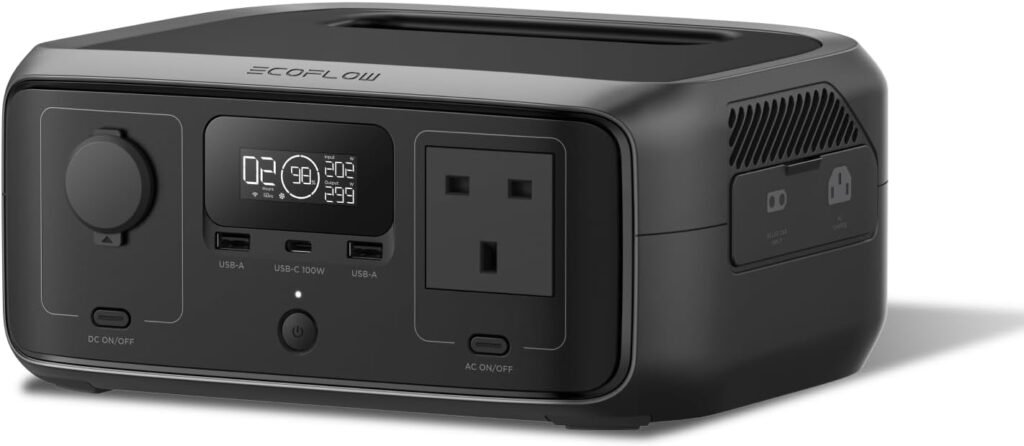

EF ECOFLOW Portable Power Station RIVER 3: An Overview
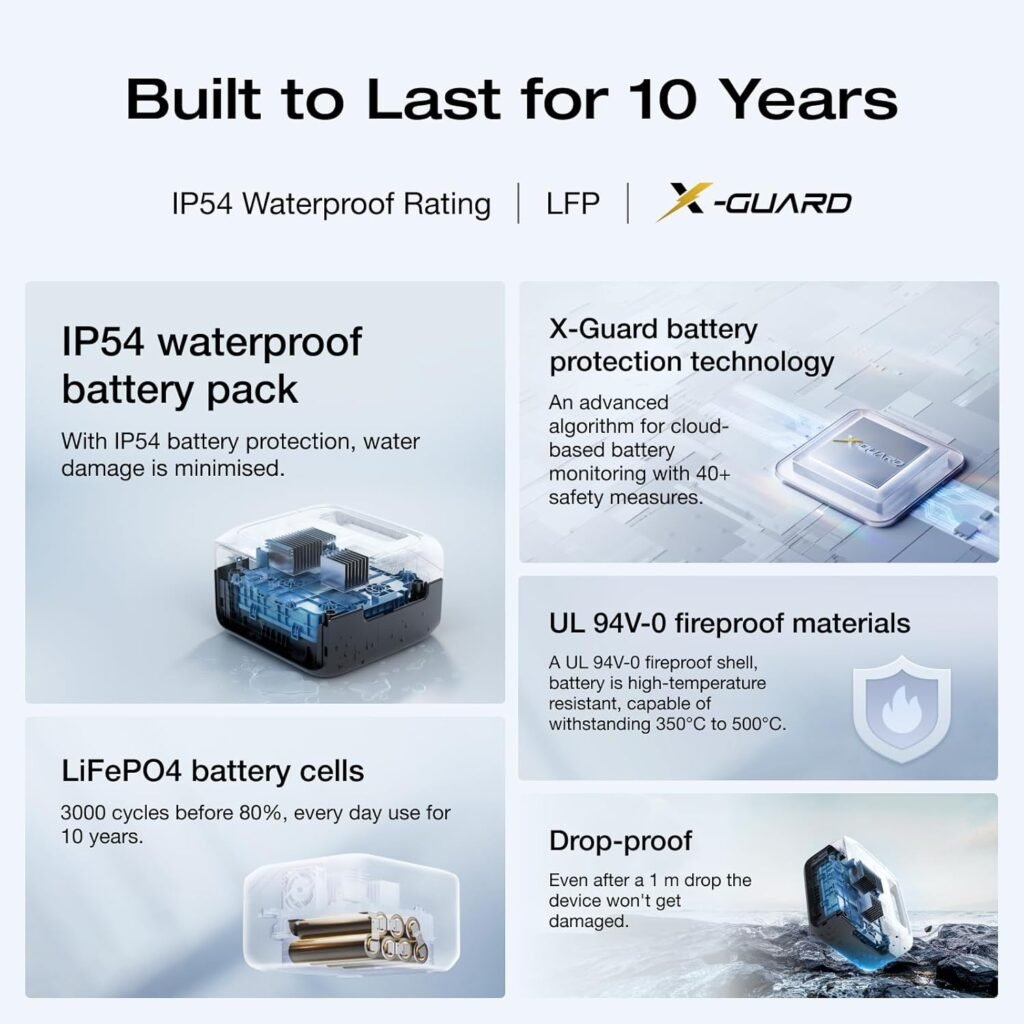
The EF ECOFLOW Portable Power Station RIVER 3 is built around a lithium iron phosphate battery, better known as LFP. That matters because many shoppers now prefer LFP chemistry for safety, stability, and long-term durability compared with older lithium-ion formats. Here, the battery capacity is 245Wh, which places it in the compact class rather than the heavy-duty backup category.
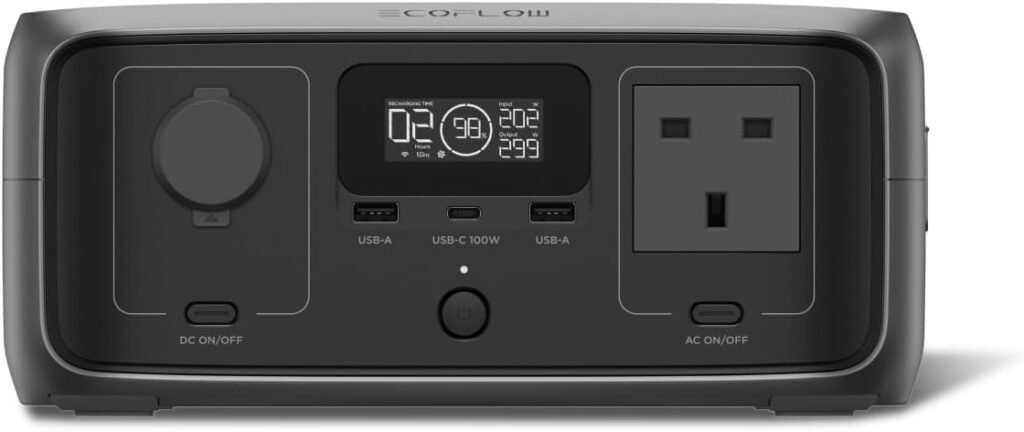
Its output profile is also clear. The unit provides 300W of continuous power for normal operation, while X-Boost is designed to support devices up to 600W, especially simpler heating loads. EcoFlow also includes an UPS switchover time below milliseconds, which is the sort of feature that attracts home users who want protection for internet gear or small office equipment.
Charging is one of the more aggressive parts of the spec sheet. EcoFlow says 0% to 100% AC charging takes hour using X-Stream. On top of that, the RIVER can be recharged from solar, a car, or a generator, giving it more flexibility than a basic wall-charge-only unit.
At a glance, this model is trying to win on speed, portability, and versatility, not huge runtime. That distinction is important before buying.
Key Features Deep-Dive
Portability is where this unit separates itself from many similarly powered competitors. EcoFlow describes the RIVER as having a flat-topped compact design with a structure optimized to reduce size by 30% compared with the industry average. That number matters more than it may seem on paper. In real use, a flatter, squarer power station is easier to slide into a van cubby, a gear shelf, or the floor of a closet without wasting vertical space.
We also like the intent behind the design language here. Some compact stations are technically portable but awkward to pack because they use rounded shells or protruding shapes that fight against bags and storage bins. This one is clearly aimed at people who move equipment often and don’t want a bulky block rolling around in the back of a vehicle.
If we were choosing this model for travel or emergency storage, we’d use it in a simple way:
- Assign it a fixed home, such as an entry cupboard, RV compartment, or work bag.
- Keep its charging cable beside it so it can be topped up quickly after each use.
- Reserve it for essential loads rather than trying to make it your only household backup source.
That approach plays directly to what the RIVER is built to do well: stay out of the way until you need it.
Extended Runtime for Appliances and Silent Operation
EcoFlow’s X-GaNPower claim is one of the more interesting parts of this model. According to the product details, it can deliver 2× runtime for appliances under 100W and provide up to 15 hours of use in suitable low-draw scenarios. That does not mean every appliance suddenly runs twice as long in all conditions, but it does suggest the unit is tuned especially well for lighter loads like lamps, small fans, modems, or charging devices.
The quiet side matters too. EcoFlow states that operating noise stays below dB at 0.5 meters. For perspective, that places it in the sort of range buyers usually want for bedrooms, tents, or shared indoor spaces. If your power station sounds like a desktop vacuum, you stop caring how smart it is. Quiet output changes how often you’ll actually use it.
This feature set makes the RIVER especially practical for:
- Overnight device support near a sleeping area
- Desk-side backup power where fan noise would be distracting
- Low-watt camping gear that benefits more from longer runtime than high surge output
For shoppers with lots of sub-100W electronics, this section of the spec sheet is one of the strongest reasons to shortlist it.

Rapid and Versatile Charging Capabilities
Fast recharging is often what separates a power station people enjoy from one they tolerate. The RIVER uses X-Stream charging, and EcoFlow says it can go from 0% to 100% on AC power in hour. For a compact unit, that is a major convenience. It means you can drain it on a short outing, get home, and have it ready again without planning your whole evening around charging time.
There is also a practical emergency benefit. If a storm warning comes in and your backup unit is half empty, an hour-long wall recharge is much easier to work around than waiting several hours. That kind of speed can matter more than a raw capacity advantage on days when timing is tight.
Here’s how we’d make the most of that charging speed:
- Top it up after every trip instead of storing it partially drained.
- Before expected outages, recharge it first and then assign it to your most important devices.
- Use fast AC charging as the reset button between outings, work use, and emergency duty.
Some rivals emphasize capacity first. EcoFlow is clearly making the case that being ready again fast is just as valuable.
Multiple Charging Options: Solar, Car, Generator
One reason compact power stations earn a place in real kits is charging flexibility, and the RIVER checks the right boxes here. Beyond wall charging, it supports solar charging, car charging, and generator charging. That broadens its use from a home backup accessory into something more mobile and resilient.
Each input route solves a different problem. Solar makes sense when you’re staying off-grid for more than a day or want to stretch the battery during daylight hours. Car charging is useful for road trips, field work, or topping up while driving between campsites. Generator charging adds another layer for households that already use a fuel-powered backup setup and want a smaller battery station for sensitive gear.
For buyers trying to choose between this and a simpler alternative, this is the sort of flexibility that improves long-term ownership. You don’t have to rely on one charging scenario. Instead, you can match the source to the situation:
- Weekend camping: use solar if you expect light daily loads
- Travel days: charge from the vehicle to arrive with reserve power
- Storm recovery: use a generator to recharge the unit for smaller indoor essentials
That versatility gives the RIVER more staying power than its small capacity alone would suggest.
High Power Output and Load Handling
Power output is where buyers need to be realistic. EcoFlow says the RIVER can keep 90% of must-have appliances running with 300W of power. That wording points toward everyday essentials, not large household loads. In practice, this means the unit is best thought of as a source for electronics, communication devices, lighting, and selected small appliances rather than a do-everything replacement for grid power.
The added X-Boost support up to 600W gives it more flexibility than a strict 300W unit. EcoFlow specifically mentions 600W heating devices, which suggests some resistive loads may run where many compact stations would simply refuse. Still, buyers should treat that as a useful buffer, not a promise that every 600W appliance will behave the same way.
We’d sort potential loads into three groups:
- Best fit: phones, laptops, routers, lights, cameras, and low-draw accessories.
- Possible fit: selected small appliances under the rated limit, especially short-use devices.
- Poor fit: larger kitchen gear, sustained heating appliances, and anything that expects substantial continuous wattage.
If your goal is broad appliance coverage, a larger model may make more sense. If your goal is dependable essential power, this output level is easier to appreciate.
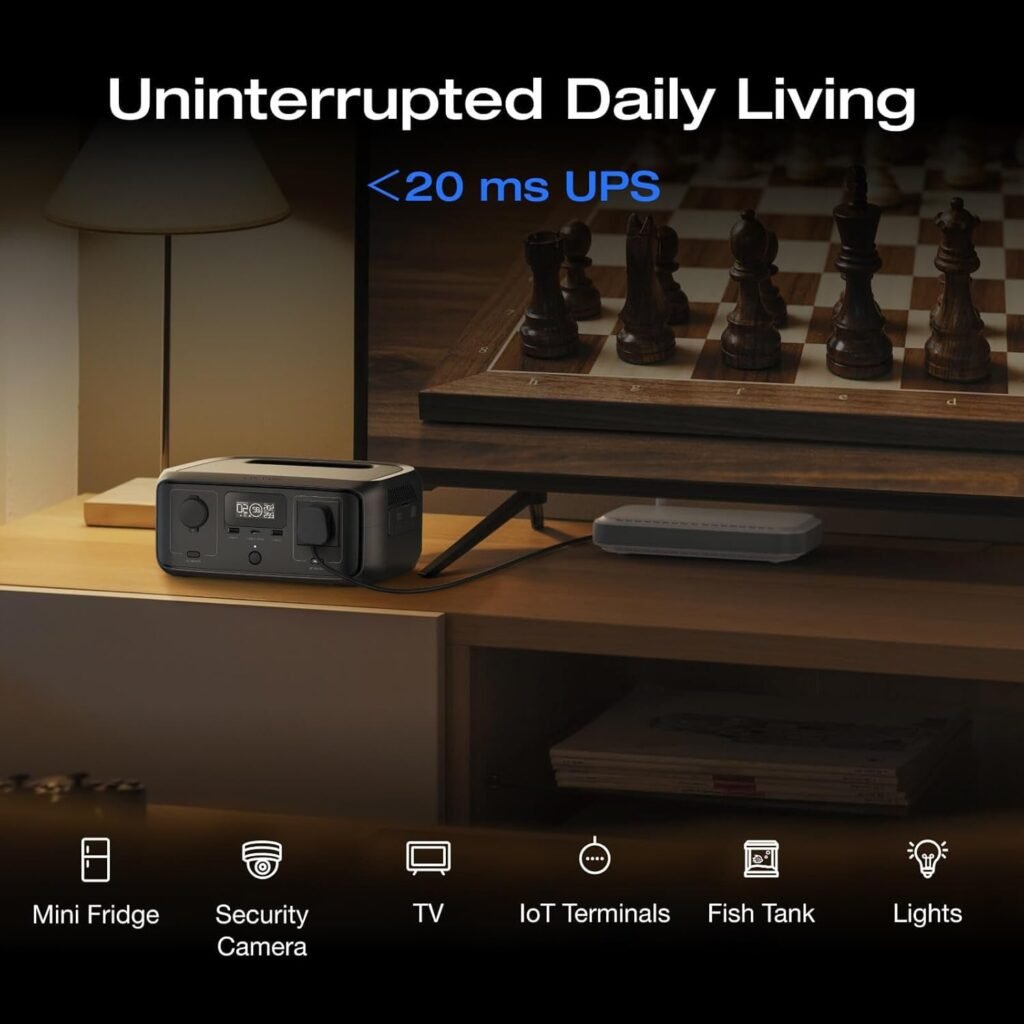
Uninterrupted Power with
The under ms UPS feature is one of the strongest reasons to consider the RIVER for home use instead of camping alone. EcoFlow says the AC outlet switches to battery supply in a barely noticeable 20 milliseconds when utility power fails. For many small electronics, that speed can be enough to prevent a disruptive shutdown.
This matters most for devices that don’t draw much power but create immediate inconvenience when they go offline. Think of your internet modem, router, basic lighting, security gear, or communication setup. Losing those for even a minute can be more frustrating than losing a larger appliance for the same period.
If we were setting it up for backup duty, we’d keep the process simple:
- Identify one or two essential circuits such as internet equipment or a small workspace.
- Connect only the critical devices that benefit from uninterrupted operation.
- Test the switchover during the day so you know exactly what stays online.
That targeted use makes far more sense than trying to turn a 245Wh unit into whole-room backup. For short interruptions and network continuity, though, this is a genuinely useful feature.
Customer Feedback and Usage Patterns
While the product details give us the technical picture, buyer feedback patterns usually tell us whether those features matter in day-to-day use. The clearest trend around a model like this is usually portability first. Shoppers who choose compact power stations tend to value easy carrying, easy storage, and quick deployment more than headline battery capacity, and that aligns closely with how the RIVER is positioned.
Based on the provided usage themes, many owners appear to respond well to fast charging and reliable short-term backup power. Those are practical wins. A battery station that recharges in 1 hour and can support essential low-watt devices during interruptions tends to feel more useful than a slower, heavier unit that stays in the closet.
The limitations are also predictable and worth taking seriously. Some buyers point to the constraints of heavy-duty appliance support, while others wish the 245Wh capacity stretched further. Neither complaint is surprising. This is not a large reserve battery, and it is not meant to run demanding gear for long periods.
That feedback pattern suggests the happiest owners are the ones who bought it for the right job: compact backup, travel power, and low-draw essentials.
Who Is the EF ECOFLOW RIVER Best Suited For?
The best buyer for this unit is someone who values mobility and readiness over maximum runtime. If you camp regularly, travel in a van, or keep a small emergency kit at home, the RIVER fits the kind of use where compact equipment gets used more often simply because it is easy to grab. A larger station may look better on paper, but many people don’t want to lift, store, or reorganize around a heavy backup box.
It also suits homeowners who want a specific safety net rather than broad outage coverage. For example, if your biggest concern is keeping a router, phone chargers, a lamp, and communication devices available during a short outage, this model makes sense. The UPS feature strengthens that case because it supports continuity, not just raw battery storage.
We think it’s a good fit for three groups:
- Outdoor users who need clean portable power for light gear
- Apartment or home users who want a small backup source for essentials
- Frequent travelers who benefit from several recharging methods
It is less suitable for shoppers who expect to power larger appliances, run multiple medium-watt devices together, or get through a long outage without recharging. In that case, step up in size.
Comparison With Similar Portable Power Stations
Shoppers comparing compact battery stations will probably also look at Bluetti and Anker. Two names that often come up in the same conversation are the Bluetti EB3A and the Anker Portable Power Station. We won’t force a winner because the right choice depends on what matters most to you, but the RIVER has a distinct angle.
Against many Bluetti alternatives, EcoFlow often appeals to buyers who prioritize fast recharge speed and a more travel-friendly form factor. Against compact Anker options, the RIVER stands out by combining LFP chemistry, UPS capability, and a design focused on fitting into tight storage spots. That gives it a more emergency-ready personality than some basic recreational units.
Here’s the simplest way to compare:
- Choose EcoFlow if recharge speed, compactness, and UPS support matter most.
- Choose Bluetti if you are cross-shopping for capacity-heavy value within the same general category.
- Choose Anker if you prefer a straightforward small-station approach and like that brand’s ecosystem.
The RIVER doesn’t try to dominate every category. It tries to be one of the easiest compact stations to live with, and that is a valid reason to pick it.
Value and Pricing Analysis
The listed price in the provided product data is ()0.00, which obviously doesn’t reflect a real market selling price. Because of that, we can’t make a precise pound-for-pound or dollar-for-dollar value judgment. What we can do is assess what kind of buyer would find the feature set worthwhile once the live price is available.
Value here depends on whether you care more about how a power station behaves than about capacity alone. You are getting a 245Wh LFP battery, 1-hour AC charging, under ms UPS, support for solar, car, and generator input, and a notably compact shell. Those are not throwaway features. They directly affect convenience, readiness, and where the unit fits into daily life.
We’d judge its value with this checklist:
- Check the live price against similar small LFP models from EcoFlow, Bluetti, and Anker.
- Decide whether UPS and recharge speed matter to you more than larger capacity.
- Estimate your typical load so you’re not overpaying for output you won’t use or underbuying for runtime you need.
If the eventual street price lands competitively, the RIVER has a convincing value story. If it is priced too close to bigger-capacity alternatives, buyers may hesitate.
What Customers Are Saying: Real Feedback and Common Themes
The broad feedback themes around the EF ECOFLOW Portable Power Station RIVER are easy to read. The praise tends to cluster around portability, quick recharge times, and the sense that it works well as a reliable backup for essentials. Those are exactly the areas where the product description spends its energy, which is often a good sign. When buyer impressions line up with the product’s stated purpose, expectations are usually being met.
The criticism is equally consistent. Some users clearly want more capacity, while others wish for higher wattage support for broader appliance coverage. That doesn’t make the product weak; it simply highlights the limits of a compact class machine. Buyers who expect a 245Wh station to behave like a large home battery will likely be disappointed.
What matters most is matching those themes to your own use case. If your daily or emergency load is modest, the strengths are likely to matter more than the compromises. If your plan includes sustained use of larger devices, you’ll probably be happier spending more on a larger platform from the start.
That is why this product feels easiest to recommend when its role is clearly defined before purchase.
Final Thoughts: Is the EF ECOFLOW Portable Power Station RIVER Worth It?
The EF ECOFLOW Portable Power Station RIVER 3 earns its place by being focused. It does not promise massive capacity, and it does not pretend to replace a larger home-backup system. Instead, it offers a small LFP battery station with a smart mix of features: fast 1-hour AC charging, quiet sub-30 dB operation, multiple recharge paths, and an under ms UPS function that makes it more useful indoors than many similarly sized rivals.
For us, the buying decision comes down to priorities. If you want the smallest practical solution for camping gear, travel electronics, internet backup, lighting, and other low-draw needs, it makes a lot of sense. If you need long runtimes or broader appliance support, its 245Wh battery and 300W continuous output will feel restrictive.
So is it worth it? Yes, for the right buyer. The RIVER looks strongest as a compact everyday backup and outdoor companion, not as a one-box answer to every outage. Buy it for portability and speed, and it should satisfy. Buy it for big loads, and you’ll want more battery very quickly.
Pros and Cons
Pros
- Very compact flat-top design with a claimed 30% smaller footprint than the industry average
- Fast AC charging from 0% to 100% in hour via X-Stream
- Useful home-backup feature with under ms UPS switching
Cons
- 245Wh capacity is modest for long outages or power-hungry appliances
- 300W continuous output limits what it can run at the same time
- Listed price of ()0.00 makes real value harder to judge until live pricing is available
Final Verdict
Key Takeaways
- The EF ECOFLOW Portable Power Station RIVER is best for compact backup, camping, van use, and low-watt essentials rather than heavy appliance duty.
- Its strongest features are the 1-hour AC recharge, under ms UPS switching, quiet operation below dB, and flexible charging options.
- The 245Wh LFP battery and 300W continuous output are practical for routers, lights, laptops, and phones, but limited for longer outages or larger devices.
- The flat-top design and claimed 30% smaller footprint make it easier to store than many similarly powered units.
- Real value depends on the live selling price, since the provided listing price of ()0.00 is not a usable benchmark.
Frequently Asked Questions
Are Bluetti power stations reliable and worth the money?
Bluetti power stations are generally considered reliable when you choose the right size for your needs. They often compete well on battery chemistry and capacity, but value depends on whether you need more watt-hours than a compact model like the EF ECOFLOW Portable Power Station RIVER provides.
Which is better, EcoFlow or Bluetti?
EcoFlow usually stands out for fast charging and user-friendly features, while Bluetti often appeals to buyers who want larger capacities in some models. If quick AC recharge and a compact footprint matter most, EcoFlow has a strong case; if maximum storage is the goal, Bluetti may be the better fit.
What’s better, Anker or Bluetti?
Anker and Bluetti both make solid portable power stations, but they often target slightly different buyers. Anker tends to focus on simple design and dependable everyday use, while Bluetti is frequently compared for battery capacity and off-grid options.
Which Bluetti power station is best?
The best Bluetti power station depends on your use case. Smaller Bluetti units suit camping and device charging, while larger models are better for home backup, so the right choice comes down to runtime needs, output demands, and how much weight you’re willing to carry.