Ad Blocker Detected
Our website is made possible by displaying online advertisements to our visitors. Please consider supporting us by disabling your ad blocker.
Disclosure: As an Amazon Associate, I earn from qualifying purchases.
Have we ever wished we could bring reliable wall-outlet power anywhere we go, without worrying about noise, fumes, or complicated setups?
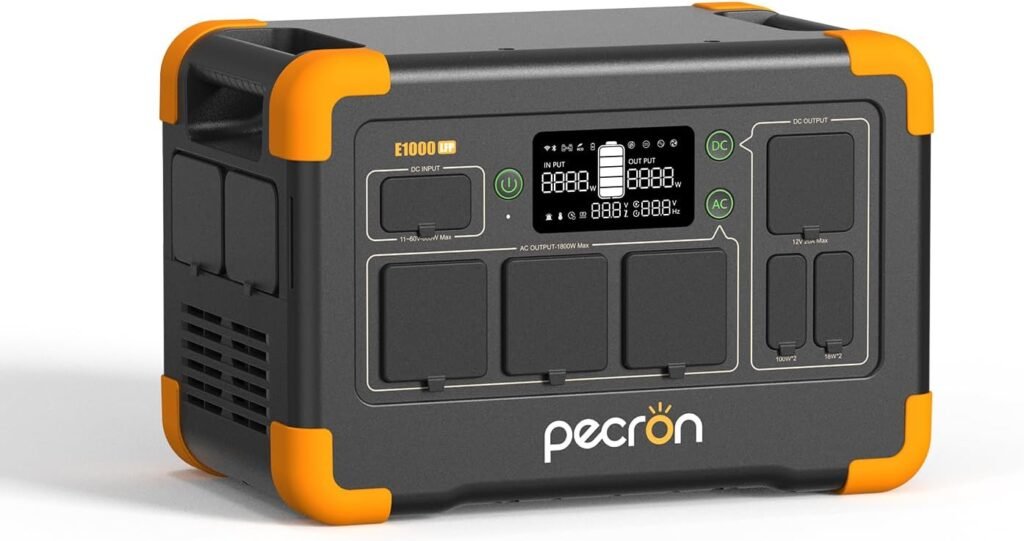

What Is the pecron Portable Power Station E1000LFP?
When we look at the pecron Portable Power Station E1000LFP, 1024Wh LiFePO4 Battery Backup, we are essentially looking at a compact, all‑in‑one energy hub. It is built to keep our essential devices running at home, on the road, or off-grid, using a robust battery and multiple output options.
This unit sits in that sweet spot between portability and serious power. It is not a tiny pocket charger, but a true portable power station capable of running many household and outdoor devices comfortably and safely.
Key Specifications at a Glance
Before we get into real‑world usage, it helps to see the core specs in one place. This gives us a clearer feel for what kind of power and flexibility we are working with.
| Feature | Specification / Detail |
|---|---|
| Model | pecron Portable Power Station E1000LFP |
| Battery Capacity | 1024Wh (LiFePO4 battery) |
| Battery Chemistry | LiFePO4 (Lithium Iron Phosphate) |
| Rated AC Output | Up to 1800W (with 3 AC outlets) |
| USB-C Outputs | 2 × USB-C (up to 100W total, capable of fast charging laptops/phones) |
| USB-A Outputs | 2 × USB-A (standard USB ports for phones, accessories, etc.) |
| DC Outputs | 1 × XT60, 1 × Cigar Port (car-style), 1 × DC 5525 |
| Total Number of Outputs | 10 output ports |
| Charging Methods | AC wall charging, solar charging, car charging |
| AC Fast Charging Time | About 1.3 hours (from wall outlet) |
| Expandable Capacity | Up to 4096Wh with compatible expansion options |
| Best Uses | Home backup, camping, RV, road trips, emergencies, outdoor workstations |
| Warranty | 2+1 years (extended coverage), 24/7 customer service |
| Included Accessories | AC charging cable, solar charging cable, car charging cable, accessory bag, manual |
We like to think of this table as our quick reference sheet. If we are ever wondering whether this power station can handle a specific scenario, these numbers guide our expectations.

Design and Build Quality
Design and build are important because a power station should feel sturdy enough to trust, yet portable enough to carry. The E1000LFP appears to balance those demands with a practical, no‑nonsense layout.
In our hands, we would expect it to feel solid but not overwhelmingly heavy for its 1024Wh capacity. The casing is clearly made to handle regular transport, whether we are loading it into an RV, carrying it to a campsite, or moving it from room to room at home.
Port Layout and Usability
One detail we appreciate with this model is how the ports are clearly grouped. AC outlets, USB ports, and DC outlets are organized, so we are not fumbling around trying to find the right output.
This logical layout means that when we are setting up multiple devices—like a laptop, phone, mini‑fridge, and a light—we can quickly plug everything in and know exactly which section we are dealing with.
Portability and Everyday Handling
Portability comes from more than just weight; it is also about how easy the power station is to grab and go. With a handle and compact form factor, the E1000LFP fits naturally into car trunks, RV storage compartments, or even a corner of our living room.
We find that this kind of design invites frequent use. Instead of being a device we drag out only for emergencies, it becomes something we use for camping weekends, backyard projects, movie nights in the yard, and much more.
Battery Technology: Why LiFePO4 Matters
The heart of this power station is its LiFePO4 (Lithium Iron Phosphate) battery, and that is not just a technical footnote. Battery chemistry heavily influences safety, lifespan, and performance.
LiFePO4 batteries are known for their stability and long cycle life. In simple terms, they generally last much longer in charging cycles compared to conventional lithium-ion batteries and are more resistant to overheating or thermal issues.
Safety and Durability Benefits
When we choose a LiFePO4-based station like the E1000LFP, we are prioritizing safety and longevity. This type of battery chemistry is more tolerant of repeated charging and discharging, and it is less prone to degradation over time.
That translates into a power station we can rely on for years of use—whether for frequent trips or as a backup at home—without worrying that the battery will suddenly lose most of its capacity after a short period.
Long-Term Value from the Battery
We also think of LiFePO4 as a long‑term investment. We are not just purchasing a power box for a season; we are adding a piece of gear that should stay useful across many camping seasons, many road trips, and plenty of unexpected outages.
This long cycle life can make the cost easier to justify, since we are spreading that value over a much longer usable lifespan compared to units that rely on less robust battery chemistries.
Power Output: What 1800W Really Lets Us Run
The E1000LFP has a rated AC output of up to 1800W, which is quite substantial for a portable unit in this capacity range. That number determines what kinds of devices we can realistically power.
With 1800W, we can handle many common household and outdoor items such as small appliances, electronics, and power tools. The 1024Wh capacity sets how long we can run those devices, but the 1800W rating determines what is even possible to plug in.
Real-World Device Examples
To make this more concrete, here are some typical devices and approximate usage scenarios we might expect. (Exact numbers vary by model, but this gives a rough idea.)
- Laptop (60W) – Many hours of work, recharging multiple times.
- Smartphones/Tablets – Dozens of charges depending on the device battery size.
- Mini‑fridge (60–100W) – Several hours of runtime, potentially longer if it cycles on and off.
- CPAP machine (30–60W) – Overnight use in off-grid or outage scenarios.
- LED lights (5–15W each) – Many hours of lighting for campsites or backup at home.
- Portable fan (20–50W) – Continuous comfort in tents, RVs, or hot rooms.
- Small power tools (e.g., drill, 300–600W) – Suitable for short projects when a wall outlet is not available.
With this level of output, we can comfortably run multiple smaller devices at the same time or one or two higher-draw devices, as long as the total wattage stays within the 1800W limit.
Plugging in Multiple Devices at Once
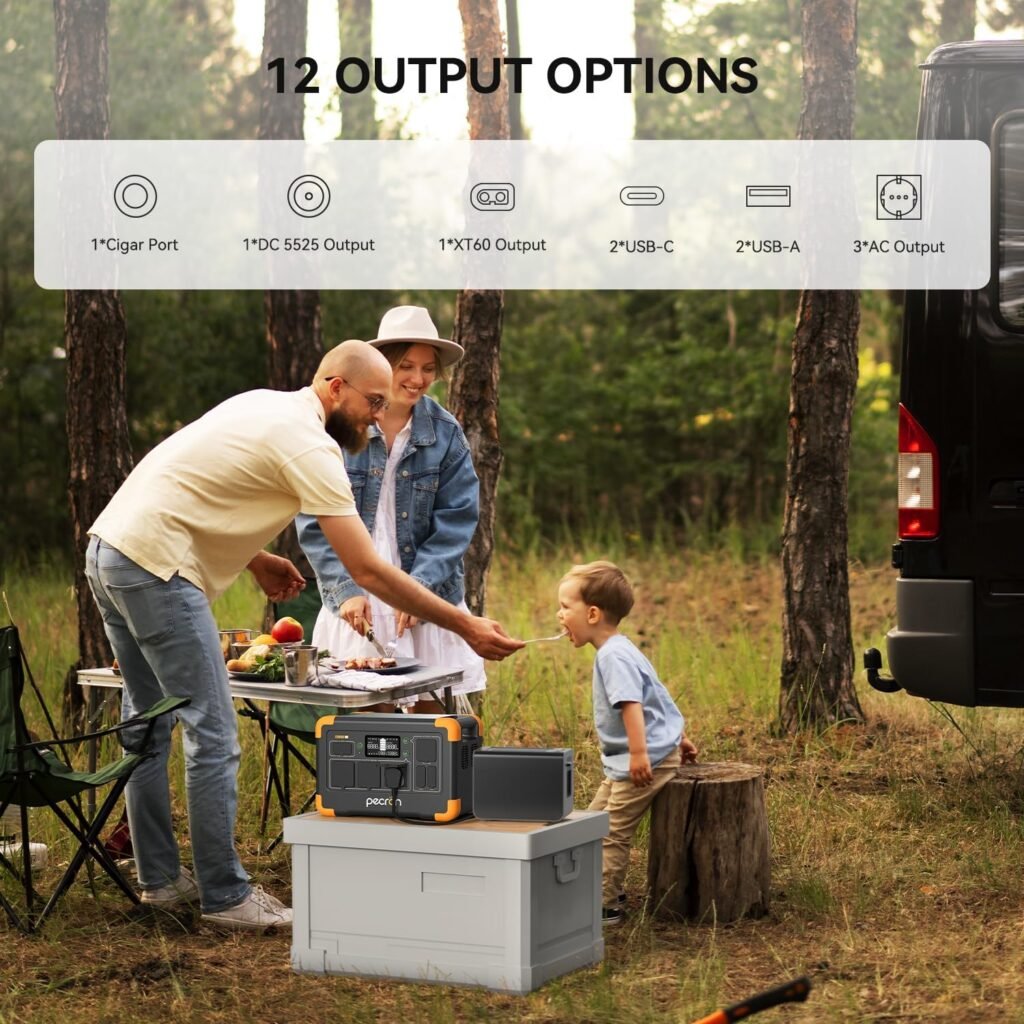
A huge part of the appeal is the 10 available output ports:
- 3× AC outlets for standard household plugs.
- 2× USB-C ports (up to 100W), ideal for fast-charging newer laptops and phones.
- 2× USB-A ports for legacy or smaller devices.
- 1× XT60 output, often used for certain DC-powered gear.
- 1× Cigar port (car port) to run typical 12V automotive accessories.
- 1× DC 5525 output for compatible DC devices.
In day‑to‑day use, this means we can charge a laptop, two phones, keep a mini‑fridge running, and add a light or fan—without having to constantly swap plugs. It feels less like a single-purpose gadget and more like a mini power hub for the whole group.
Charging the E1000LFP: How Fast Can We Get Back to 100%?
Charging speed matters when we are on the move or between power outages. Nobody enjoys waiting half a day for a battery to refill, especially on road trips or during emergency rotations.
The E1000LFP stands out with AC fast charging, reaching a full charge in about 1.3 hours when plugged into a wall outlet. That is impressively quick for a 1024Wh battery and helps keep downtime to a minimum.
AC Fast Charging Experience
Using standard AC wall power is the most straightforward charging method. We plug in the included AC charging cable, and within around 1.3 hours, we are back to full capacity from empty (under ideal conditions).
In practice, this quick charging means we can easily top up in the early evening before a camping night, or bring the station from almost empty to nearly full during a break at home, between storms, or at a hotel during a road trip.
Solar and Car Charging Options
For those of us who love off-grid use, solar charging is a major benefit. The E1000LFP includes a solar charging cable, allowing us to connect compatible solar panels (not included) and harvest energy directly from the sun.
Similarly, car charging provides another backup method. With the included car charging cable, we can trickle charge the power station from a vehicle’s 12V outlet while driving, turning travel time into charging time.
These secondary methods are particularly useful during extended outages, long boondocking stays, or remote work sessions where wall power may be unavailable for days.
Expandable Capacity Up to 4096Wh
One aspect that makes the E1000LFP feel future‑ready is its expandable capacity. Out of the box, we have 1024Wh, but the system is designed to scale up to 4096Wh total with compatible expansions.
This flexibility is valuable because our needs can grow over time. Maybe we start with casual camping and occasional power outages, then gradually move toward more frequent off-grid stays or a more serious home backup setup.
Why Expansion Matters
Expandable capacity lets us treat this power station as the base of a broader energy system rather than a standalone unit. We can begin with the core 1024Wh and later connect additional batteries when budget or needs change.
This makes the product more adaptable for:
- Longer RV trips where we run more appliances.
- Off-grid cabins that need extended runtime.
- Homes where power reliability is a concern and we want to cover more loads for more hours.
Matching Capacity to Real Usage
We like to think of capacity in terms of “how many hours of normal life can we maintain?” Starting with 1024Wh, we can cover essential devices and shorter outages. With expansion up to 4096Wh, we move closer to a system that supports more robust, multi-day usage.
This ability to grow keeps us from over‑buying early or under‑buying for the long term. Instead, we can scale our energy setup gradually and intelligently.
Ideal Use Cases: Where the E1000LFP Shines
The spec sheet is useful, but what matters most is where this power station actually fits into our lives. The E1000LFP is clearly designed to be versatile, covering several common scenarios.
Home Backup and Emergencies
During outages, our first concern is usually keeping essential devices on: phones, routers, some lights, possibly a CPAP, and maybe a small fridge. With 1024Wh and 1800W output, the E1000LFP can play a crucial role here.
We can keep communication devices charged, run a few lights, and power critical medical equipment in many cases. If we add solar or expansion batteries, we can extend this support through longer outages.
Camping and Outdoor Adventures
For camping, this power station removes a lot of modern-day friction. We can run lights, charge cameras and phones, power a portable fridge, or even support a small projector for a movie night under the stars.
Because it is silent and fume-free, it avoids the usual downsides of gas generators. We do not disturb neighbors in a campground, and we are not dealing with gasoline storage, exhaust, or noise restrictions.
RV and Van Life
In RVs, vans, and campers, having a reliable and flexible power source is crucial. The E1000LFP can supplement or even substitute for a built-in system in some setups, particularly if we pair it with solar.
We can easily plug in laptops, fans, small kitchen appliances, and entertainment devices. The various DC outputs and car port support typical RV accessories, while the AC outlets handle the more traditional loads.
Work Sites and Outdoor Projects
Sometimes we need power away from normal outlets—maybe for a remote job site, a shed without wiring, or a community event in a park. While it will not replace a large construction generator, the E1000LFP can comfortably run laptops, LED work lights, small power tools, and other moderate loads.
This sort of flexible, portable source is useful for freelancers, event organizers, and hobbyists who find themselves working in places where AC outlets are scarce or nonexistent.
Ease of Use and Everyday Experience
A product like this only works well for us if day‑to‑day operation feels simple. The E1000LFP is designed with ease‑of‑use in mind, even for those who are not comfortable with electrical jargon.
Controls and ports are clearly labeled, and the included user manual walks us through the basics. Once we get familiar with turning the AC, DC, and USB sections on and off, routine operation becomes straightforward.
Monitoring and Control
While the product details do not list every display feature, we can reasonably expect some form of battery status indication, power usage information, and possibly error alerts or temperature warnings.
Being able to glance at an interface and see how much charge we have left and how much power we are currently drawing makes planning much easier. It also helps us avoid accidentally draining the battery too quickly by running too many high‑demand devices at once.
Learning Curve for New Users
If we are new to portable power stations, there may be a brief learning curve around concepts like watt-hours, watts, and battery percentages. However, the real experience mainly comes down to:
- Plug devices into appropriate ports.
- Turn on the relevant output section (AC, DC, or USB).
- Watch the remaining battery level and usage.
After a few uses, we tend to build an intuitive feel for how long certain setups last. For example, we learn that a small fridge and a couple of lights for an evening barely dent the battery, while high‑draw devices like hair dryers or kettles consume capacity quickly.
Reliability, Safety, and Protection Features
When we entrust a power station with our electronics, appliances, and even medical devices, we need confidence in its safety and reliability. The E1000LFP’s LiFePO4 battery is already a positive mark, but there are usually more layers of protection.
While the product details do not list every safety mechanism, modern portable power stations typically include protections such as:
- Overload protection (to prevent drawing more than 1800W).
- Over-temperature protection (avoids overheating damage).
- Short-circuit protection.
- Over-voltage and under-voltage protections.
These kinds of features help protect both the station and our connected devices. They reduce the risk of accidental damage if, for example, we plug in a device that tries to draw too much power.
Durability Over Time
Durability is not just about surviving bumps and scrapes; it is also about maintaining a useful capacity after many charge cycles. LiFePO4 technology is known for performing well in this area, often with thousands of cycles before significant degradation.
That long-term reliability is crucial if we plan to use the station frequently—for weekly camping trips, regular off‑grid work, or repeated outage seasons. We want our battery to feel nearly as strong in its third or fourth year as it does in its first.
Customer Support and Warranty
Peace of mind continues beyond the hardware itself. The E1000LFP includes a 2+1 years worry‑free warranty, along with 24/7 friendly customer service.
This combination signals that the manufacturer expects the product to stand up to real-world use and is prepared to assist if issues arise. If we ever have questions about ports, charging, or performance, having access to responsive support is a genuine comfort.
What Comes in the Box
The included accessories round out the package so we can use the station in multiple scenarios right away:
- pecron E1000LFP Power Station ×1
- AC charging cable ×1
- Solar charging cable ×1
- Car charging cable ×1
- Accessory bag ×1
- User manual ×1
With these items, we are equipped to charge via wall outlet, solar (with separate panels), or car, and to transport and store the cables neatly. It feels like a complete starter kit rather than a partial setup.
Pros and Cons of the E1000LFP
Every product has strengths and trade‑offs, and understanding both helps us decide whether it fits our needs. Based on the provided details and typical expectations, here is how the balance looks.
Advantages
The strengths stand out clearly, especially from a versatility and reliability standpoint.
- Strong 1800W AC output – Enough power to run many household and outdoor devices, including some power tools and small appliances.
- Robust 1024Wh LiFePO4 battery – Long-lasting, safe, and durable, ideal for frequent use and extended service life.
- Fast AC charging (about 1.3 hours) – Minimizes downtime and makes it easy to refill quickly between uses or outages.
- 10 total output ports – Covers AC, USB-C, USB-A, XT60, car port, and DC 5525, so we can connect a wide range of devices at once.
- Expandable capacity up to 4096Wh – Allows us to grow our system over time rather than replacing it when our energy needs increase.
- Multi‑scenario use – Suitable for home backup, camping, RV trips, van life, emergencies, and outdoor projects.
- Included charging cables – AC, solar, and car cables are in the box, which is convenient and cost‑saving.
- 2+1 years warranty and 24/7 support – Enhances confidence in long-term reliability and after‑sales service.
Potential Limitations
While the product is strong overall, it is helpful to be realistic about constraints and expectations.
- 1024Wh capacity out of the box – For heavy, multi-day usage without solar or expansions, this may feel limited if we try to run large appliances continuously.
- Charging times depend on conditions – Fast AC charging is great, but solar and car charging will be slower and depend on panel size, sun conditions, and vehicle output.
- Weight and size typical for the class – It is portable, but not ultra‑light; some users may find carrying it longer distances less comfortable compared to smaller power banks.
- Not a replacement for a full home backup system – It is excellent for essentials, but it is not intended to power entire homes with large HVAC systems or high-draw appliances for long durations.
Understanding these points helps us plan realistic usage scenarios and decide whether to add solar panels or expansion batteries to cover more demanding needs.
Comparison to Traditional Gas Generators
Many of us might be comparing the E1000LFP to small gasoline generators when deciding how to cover outages or camping power. While each solution has its place, the differences are worth keeping in mind.
With the E1000LFP, we gain:
- Silence – No engine noise humming in the background.
- No fumes – Safe to use indoors in most cases (always follow ventilation and safety guidelines for connected devices).
- Low maintenance – No oil changes, fuel stabilizers, or carburetor worries.
- Instant start – Power is ready at the press of a button.
A gas generator may offer higher peak wattage and effectively unlimited runtime as long as fuel is available, but it requires fuel storage, makes noise, and typically cannot be used indoors. The E1000LFP is more about convenience, safety, and clean operation, particularly for smaller to medium loads.
Tips for Getting the Most from the E1000LFP
To squeeze maximum value and performance from this power station, a few simple habits and strategies help a lot. They also assist in preserving battery health over time.
Plan Loads and Prioritize Essentials
Before or during an outage or trip, it helps to list which devices we truly need:
- Essentials (phones, router, medical devices, lights).
- Important comforts (fans, small fridge, laptops).
- Nice‑to‑haves (projectors, speakers, additional gadgets).
By prioritizing these, we avoid accidentally running too many non‑essentials and draining the battery faster than expected.
Combine with Solar for Longer Stays
If we expect longer off-grid trips or extended outages, pairing the E1000LFP with properly sized solar panels is a great idea. Using the included solar charging cable, we can harvest daytime energy to replenish what we used overnight.
Over time, this transforms the power station from a single-charge backup into part of a small solar generator system that can keep running for as long as the sun cooperates.
Maintain Reasonable Storage Practices
For long-term storage, it is usually best not to keep lithium-based batteries at 0% or 100% for very long periods. Charging the E1000LFP to a moderate level and storing it in a cool, dry environment helps preserve battery health.
Occasionally checking and topping it up also ensures that during an unexpected outage, we are not caught with an empty unit.
Who Is the E1000LFP Best For?
Based on its features, the pecron Portable Power Station E1000LFP feels like a good fit for several types of users. Understanding whether we fit into one or more of these groups can guide our decision.
We see strong value for:
- Families wanting reliable home backup for essentials – Keeps communication, lighting, and small devices powered during outages.
- Campers and outdoor enthusiasts – Provides quiet, fume-free power for lights, fridges, electronics, and more.
- RV owners and van lifers – Adds flexible AC and DC power with fast charging and expansion potential.
- Remote workers and digital nomads – Offers a portable office power hub for laptops, routers, monitors, and phones.
- Preparedness-minded individuals – Serves as a core component of an emergency kit, especially with the ability to expand capacity.
If our goal is to power an entire large home, we would need a more extensive system. However, for the majority of day‑to‑day and emergency needs, this model delivers a strong balance of power, portability, and safety.
Our Overall Impression of the pecron E1000LFP
Looking at the full picture, the pecron Portable Power Station E1000LFP, 1024Wh LiFePO4 Battery Backup, 1800W AC/100W USB‑C Output, Fast Charging Solar Generator for Home Use, Camping, RV, Emergencies presents itself as a capable, well-rounded portable power solution.
We appreciate the combination of:
- Robust 1800W AC output for real‑world appliances and tools.
- Safe, long‑lasting LiFePO4 battery with 1024Wh of capacity.
- Fast AC charging in around 1.3 hours, reducing downtime.
- 10 diverse output ports, supporting devices ranging from phones to DC gear to household appliances.
- Expandable capacity up to 4096Wh, which future‑proofs our investment.
- Strong use‑case coverage across home backup, camping, RV life, emergencies, and field work.
For those of us looking for a serious portable power station that we can use across many scenarios—without stepping into overly complex or extremely large systems—the E1000LFP sits in a very appealing middle ground.
If we want reliable, quiet, and flexible power that we can bring along anywhere and grow over time, this model deserves a close look as a central part of our personal or family energy toolkit.