Ad Blocker Detected
Our website is made possible by displaying online advertisements to our visitors. Please consider supporting us by disabling your ad blocker.
Disclosure: As an Amazon Associate, I earn from qualifying purchases.
Are we looking for a single power solution that can handle weekend camping, a full-house outage, and even run heavy appliances without breaking a sweat?

Product Overview
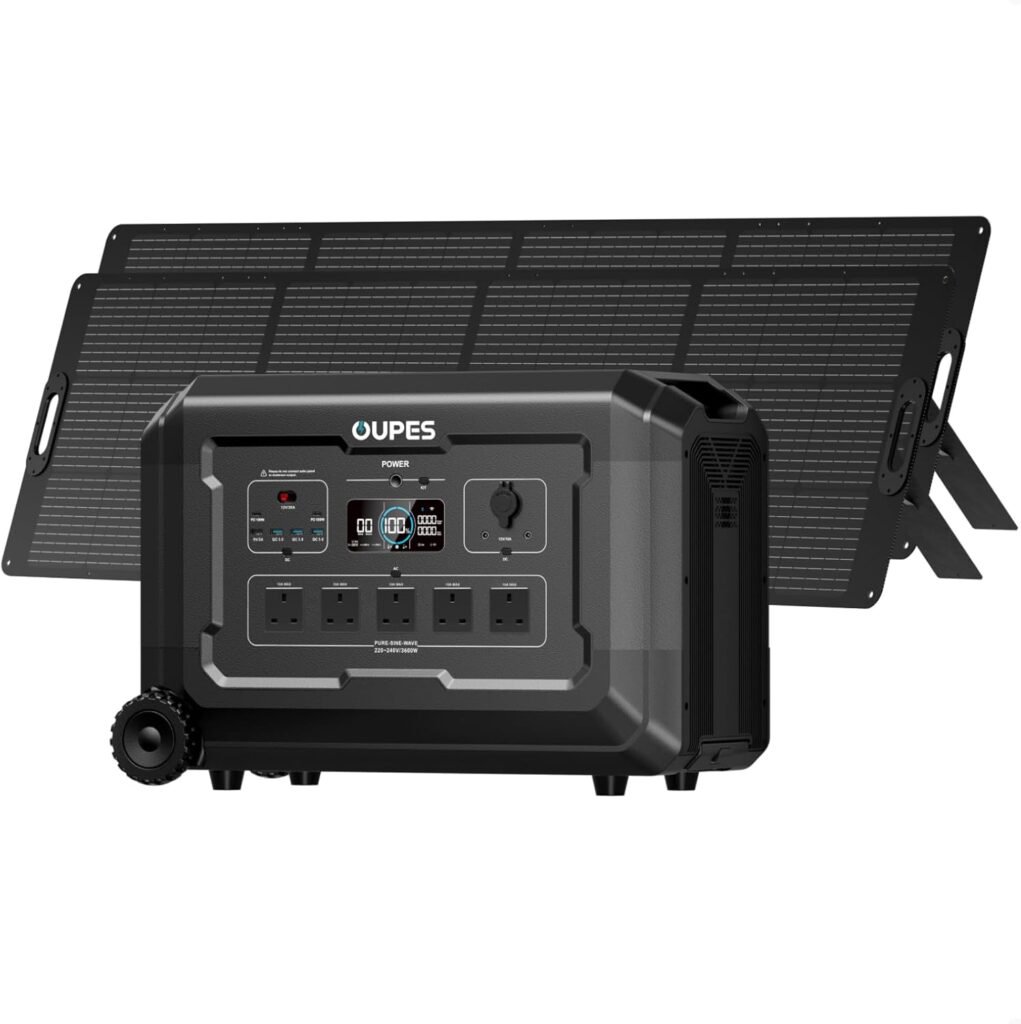
We think the OUPES Mega 3 Portable Power Station with 2x 240W Solar Panels, 3072Wh Solar Generator, 3600W(7000W Peak) AC/48 Min Fast Charge, Expandable to 15kWh, Backup Power with UPS for Home, Camping, Off-grid is positioned as a heavy-duty, flexible solar generator kit for users who want serious backup and off-grid performance. We like that it combines a large LiFePO4 battery, high continuous inverter output, expandable capacity, and fast hybrid charging in a single package designed for both home backup and outdoor use.
Key Features
We can summarise the standout points quickly: 3,072Wh base capacity with LiFePO4 chemistry, 3,600W continuous (7,000W peak) AC output via five outlets, two foldable 240W monocrystalline solar panels, hybrid AC+solar charging up to 3,900W for a full charge in about 48 minutes, and expandability up to 15.36kWh using six B2 battery packs. We find these features useful whether we’re powering high-load appliances at home during an outage or running multiple devices while camping or RVing.
What’s in the Box
We receive 1 x Mega 3 Portable Power Station, 2 x 240W Solar Panels, 1 x AC Charging Cable, 1 x Anderson-to-Car Charging Cable, 1 x Anderson-to-MC4 Cable, and 1 x User Manual. We appreciate that the kit arrives ready to start capturing solar energy and charging the station, and that the package includes the cables needed to connect the panels and to use the station in a vehicle environment.
Technical Specifications
We like to get the hard numbers in front of us so we can assess fit for our needs. Below is a compact table that breaks down the main technical specifications so we can quickly compare capacity, outputs, charging speeds, and physical data.
| Specification | Detail |
|---|---|
| Battery Capacity | 3,072 Wh (LiFePO4) |
| Expandable Capacity | Up to 15.36 kWh (with 6x B2 2048Wh batteries) |
| Inverter Output | 3,600 W continuous, 7,000 W peak |
| AC Outlets | 5 x 3600W (7000W peak) rated outlets |
| USB-C / PD | 2 x 100W PD USB-C |
| USB-A | 4 x USB-A |
| DC Ports | 2 x DC5521, 1 x Anderson, 1 x 12V Car lighter port |
| Solar Panels | 2 x 240W monocrystalline, 23% conversion |
| Panel Weight & Folded Size | 18.48 lbs each; folded 26.1 x 23.2 x 2.4 in |
| Max Input (Hybrid) | 3,900 W (AC + Solar) |
| Max Solar Input | 2,100 W |
| Max AC Input | 1,800 W |
| Full Charge (Hybrid) | ~48 minutes (max 3,900 W) |
| Battery Cycles | 3,500 cycles to 80% capacity (LiFePO4) |
| UPS Switchover | ~20 ms |
| Battery Management | BMS with overcharge/over-discharge/short/thermal protection |
| Weight (Power Station) | (Manufacturer listing required) |
| App | Wi-Fi/Bluetooth iOS & Android |
We find this table helpful when planning which loads and scenarios are realistic, and it gives us a quick reference for charging and expansion options.
Performance and Output
We watch continuous output and surge capacity closely, and the Mega 3’s 3,600W continuous inverter is a major advantage for heavy loads. The 7,000W peak handles startup surges from motors and compressors, which means fridges, freezers, and some air conditioners have a better chance of starting reliably.
AC Output and High-Power Appliances
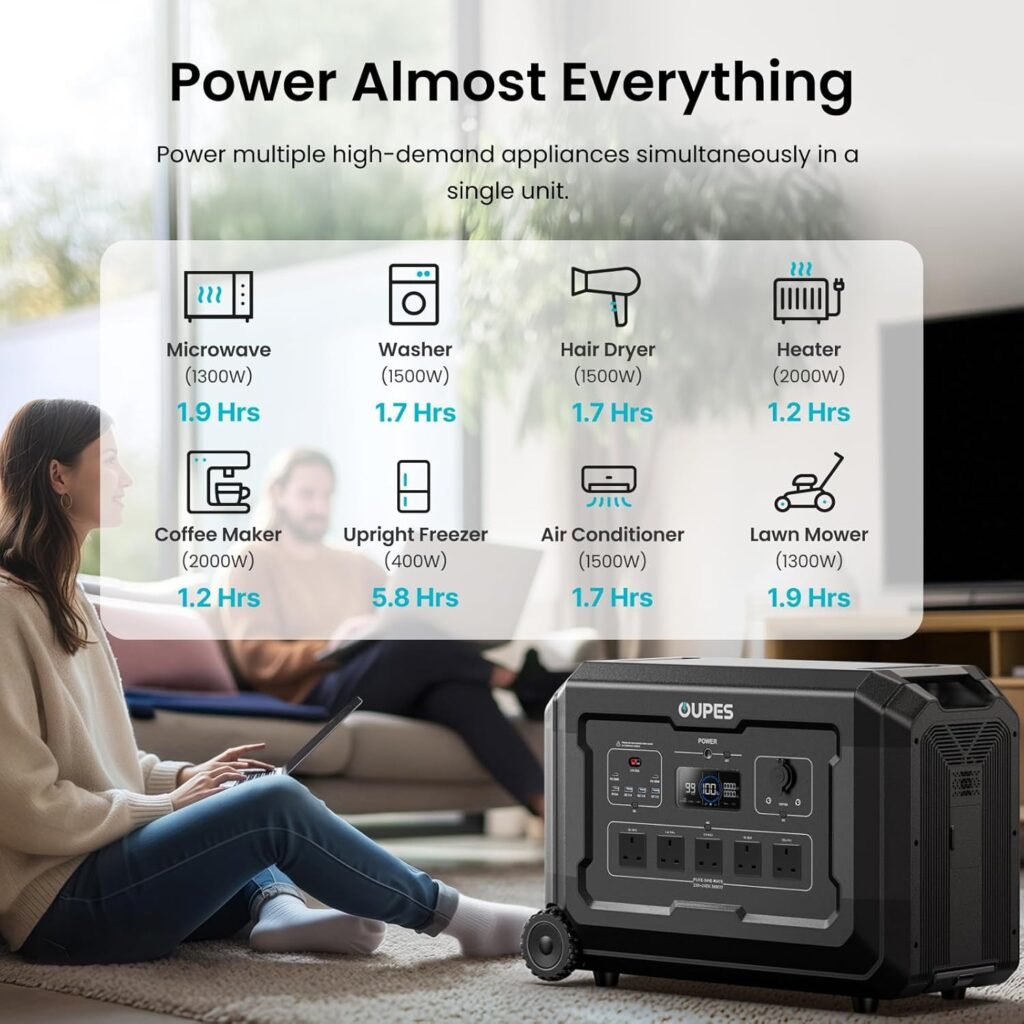
We can run a lot of standard household devices directly from the AC outlets: microwaves, coffee machines, induction cookers, electric grills, and many portable air conditioners depending on their starting requirements. Because the inverter supports 3,600W continuous, multiple medium-to-high-draw appliances can run concurrently, though we should always check combined wattage. The 7,000W peak is particularly useful for devices with high startup currents like refrigerators, well pumps, and power tools.
USB, DC and Other Ports
We like that the Mega 3 offers a total of around 15 output ports, meaning we can charge laptops, phones, cameras, and smaller DC devices simultaneously without adapters. Two 100W PD USB-C ports allow fast charging for modern laptops and phones, while the USB-A ports cover legacy devices. The Anderson and DC5521 ports make it straightforward to connect auxiliary batteries, car devices, and certain DC appliances.

Charging and Recharge Times
We’re often more interested in how fast we can top up the battery because a long recharge is inconvenient in rollout scenarios. The hybrid charging capability—combining AC and solar inputs—gives us a practical advantage: when we have access to both grid power and strong solar, we can fully recharge the unit in about 48 minutes. If we only have AC or solar, times increase to about 1.5–1.7 hours depending on mode and available sunlight.
AC, Solar, Generator, and Hybrid Charging Modes
We can charge the Mega 3 by AC (up to 1,800W), by solar (up to 2,100W), by generator (up to 1,800W), or by hybrid AC+solar (up to 3,900W). The hybrid charging mode is ideal when we want the fastest top-up and have both AC and solar available. We also appreciate the flexibility to choose the charging mode that best preserves battery health or meets time constraints.
Fast Charge vs Slow Charge: When to Use Each
We tend to use the 1,800W fast AC charge when we need power quickly—say, preparing for an incoming storm or replenishing after a day of heavy solar usage. For regular, non-urgent charging we prefer the 900W slow option because it’s gentler on the battery and can extend long-term life. The app integration allows us to pick the charging speed remotely, which is handy when we’re not physically near the unit.
Battery and Longevity
We prefer LiFePO4 chemistry for battery banks that will be cycled frequently, and the Mega 3’s LiFePO4 cells promise greater longevity and safety than many lithium-ion alternatives. The rating of over 3,500 cycles to 80% capacity suggests a usable life of a decade or more with typical household or seasonal usage, assuming sensible charging habits.
Cycle Life and Realistic Lifespan
We can expect the battery to retain useful capacity for many years; 3,500 cycles translates to daily use for roughly 10 years or heavy seasonal use for decades. The BMS protects against the typical battery hazards—overcharging, over-discharging, short circuits and overheating—so our battery health is actively managed and internal safety is prioritized.
Expandability: Adding Extra Batteries
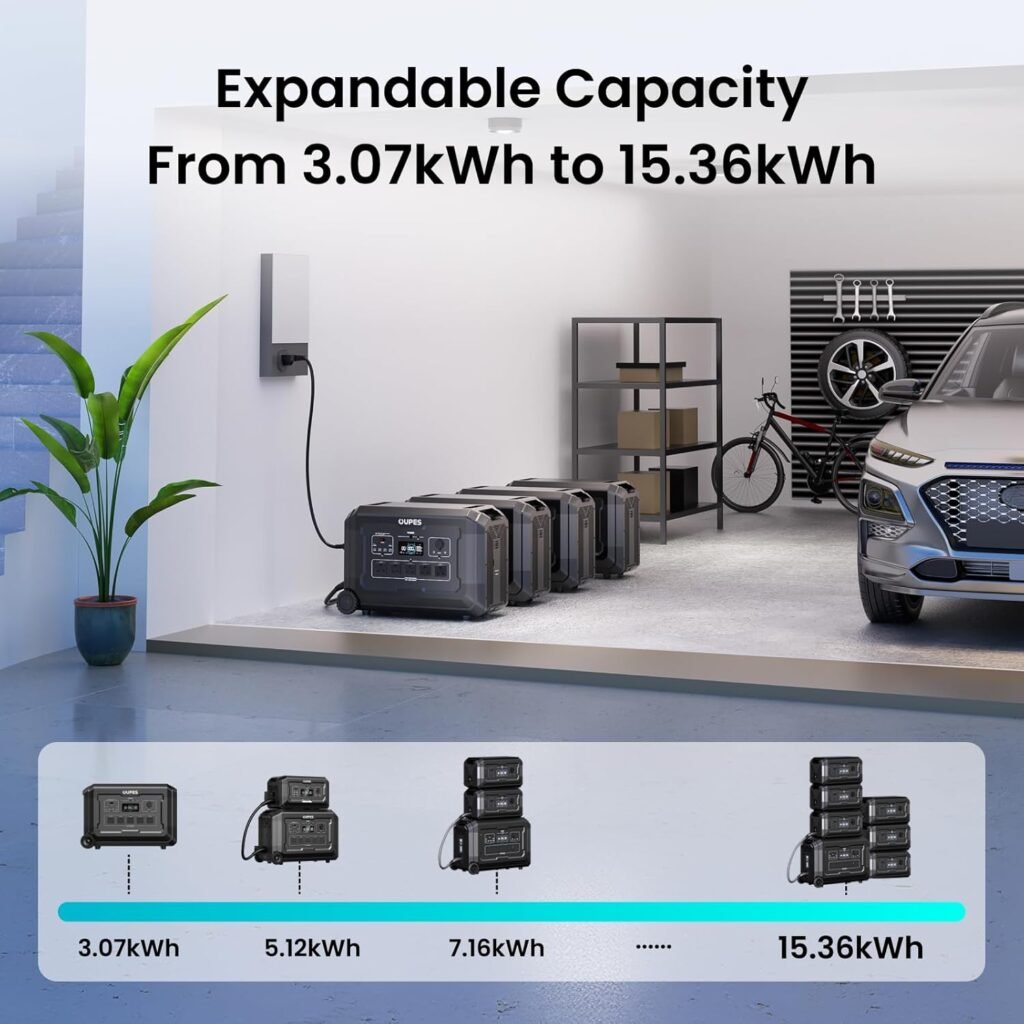
We like that the Mega 3 can be expanded to 15.36 kWh by adding six B2 extra batteries at 2,048Wh each. That flexibility is excellent for households that only need 3 kWh for occasional outages but want the option to scale to whole-house reserve power later. When configured with the additional batteries, the Mega 3 becomes a serious off-grid bank capable of carrying larger loads for extended outages or off-grid living.
Portability and Solar Panels
We find portability to be a balancing act: the power station itself is heavy by design because of its large LiFePO4 cells, but the included solar panels are designed to be transport-friendly. Each 240W panel folds compactly (26.1 x 23.2 x 2.4 inches folded) and weighs about 18.48 lbs, which makes them manageable for two-person setups and easy to stow in an RV or car trunk.
Setup and Handling in the Field
We can get the panels out, angle them toward the sun, connect to the Anderson-to-MC4 cable, and start charging the Mega 3 quickly. The foldable design helps reduce setup time, and the panels’ 23% conversion efficiency gives us good power output even on moderately sunny days. We recommend choosing a stable, slightly elevated position and keeping the panels clean to maintain maximum efficiency.
Safety, Management, and App Control
We appreciate the integrated BMS for safety, and the smart app provides real-time monitoring, charging controls, and settings adjustments. The 20ms UPS switchover is fast enough to avoid most interruptions to computers and essential devices, and the app allows us to set AC timeouts and choose charging speed without digging through menus on the unit.
UPS Functionality and 20ms Switchover
We find the UPS feature particularly valuable for sensitive electronics and devices like CPAP machines; a 20ms switchover prevents typical data loss and keeps sleep therapy devices running uninterrupted. While mission-critical server racks may require true zero-transit UPS systems, for residential uses and consumer electronics 20ms is effectively seamless.
App Features and Remote Control
We like that the app supports both Wi-Fi and Bluetooth, is compatible with iOS and Android, and gives us the ability to monitor input/output power, battery percentage, and historical usage. Being able to change charging speeds and set AC timeout remotely is a practical convenience for managing power preferences even when we’re not with the unit.
Real-World Use Cases
We find this unit suitable for a variety of scenarios, from emergency home backup and off-grid cabins to car-camping and RV usage. The combination of large base capacity, high output, and fast charging makes the Mega 3 versatile for users who want to cover both daily electronics and occasional high-power needs.
Camping and Off-Grid Trips
We can run lights, portable refrigerators, multiple phones and laptops, and even cookers during multi-day trips when we pair the station with the included panels. The panels make daytime recharging effective, and fast hybrid charging gives us flexibility to top up quickly when we arrive at a campsite with shore power.
Home Outages and Emergency Backup
We can keep essential circuits alive—refrigeration, medical devices such as CPAP machines, communication devices, and lighting—during grid outages. With expandability to 15.36kWh, we can build a system that covers longer outages and larger loads as budgets and needs grow.
RVs, Caravanning, and Road Trips
We think RV and caravan owners will appreciate the combination of inverter power, solar capability, and DC/Anderson ports to tie into vehicle electrical systems. The Anderson-to-car cable and the included car lighter port make vehicle charging and partial integration into RV setups straightforward for on-the-road users.
Estimated Run Times for Common Appliances
We like working with practical numbers, so the following table offers ballpark run times based on the 3,072Wh battery and assumptions about inverter efficiency and continuous draw. These are estimates to help us plan use; real-world durations will vary with actual power draw, inverter losses, and battery state-of-charge.
| Appliance | Approx. Average Draw (W) | Estimated Run Time (hours) |
|---|---|---|
| Smartphone (charging) | 10 W | ~270 hours (many devices simultaneously) |
| Laptop (average) | 60 W | ~46 hours |
| LED Lighting (10 bulbs x 8W) | 80 W | ~35 hours |
| Mini Fridge | 100–200 W (avg 150W) | ~18 hours |
| Portable AC (small, ~1000W) | 1,000 W | ~2.7 hours |
| Microwave | 1,200 W | ~2.3 hours |
| Coffee Maker | 900–1,200 W | ~2–3 hours cumulatively |
| Electric Grill / Induction Cooktop | 1,500–2,000 W | ~1.3–1.8 hours |
| CPAP Machine | 30–60 W | ~46–91 hours |
| Small Sump Pump (intermittent) | 700–1,200 W | Intermittent use; hours vary |
We base run-time math on usable Wh = 3,072 Wh * roughly 0.9 inverter efficiency, then divide by the appliance wattage. These figures are illustrative; actual results depend on duty cycle and peak startup currents.
Pros and Cons
We like to weigh strengths and limitations so we can make considered choices. Below we list what we think are the most important pros and cons for typical buyers.
Pros:
- High continuous and peak inverter capacity (3,600W / 7,000W peak) suitable for many heavy appliances. We can run multiple devices at once without compromising.
- Fast hybrid charging (full in ~48 minutes) that is genuinely useful after long days off-grid or prior to planned outages.
- LiFePO4 battery chemistry with 3,500+ cycles to 80% – this gives us long-term value and better thermal stability and safety.
- Expandable to 15.36kWh, allowing phase growth from a portable system to a serious backup reserve.
- Comprehensive port selection (AC, PD USB-C, USB-A, DC, Anderson) for broad compatibility.
- Foldable 240W solar panels with high conversion (23%) for efficient solar charging in compact form.
Cons:
- The base unit is a heavy investment and the power station itself is relatively heavy compared to small portable options; portability for one person is limited.
- While 20ms UPS is excellent for consumer electronics and medical devices like CPAPs, some enterprise-level servers or telecom infrastructure may require millisecond-zero transfer.
- Additional batteries to reach full expansion (15.36kWh) are a significant extra cost and some technical setup.
- Solar panel weight (~18.48 lbs each) is manageable but not ultralight for solo backpacking missions.
Comparisons with Similar Models
We find it useful to compare the Mega 3 with similarly positioned systems in the market. In our view, the Mega 3 competes with other large-capacity portable power stations that offer LiFePO4 chemistry, high inverter capacity, and fast charging. Each brand emphasizes different trade-offs—some prioritize lighter weight, others prioritize modular expansion or integrated AC charging speed.
How the Mega 3 Stands Out
We like the balance the Mega 3 strikes: exceptionally fast hybrid charging, strong continuous inverter output, high cycle life from LiFePO4, and package convenience with two 240W solar panels included. If we value expandability and long-term lifecycle, the Mega 3 is compelling; if we prioritize ultralight backpacking, we’d look elsewhere.
Installation and Maintenance Tips
We recommend placing the power station on a stable, ventilated surface away from direct rain or excessive heat. For the panels, a slight angle toward the sun and keeping them clean will improve performance, and using the Anderson-to-MC4 cable ensures a secure solar connection.
Battery Care and Best Practices
We generally avoid leaving the battery at 0% for extended periods and prefer regular top-ups; when storing for long periods, maintaining a 40–60% state of charge and periodic maintenance cycles helps long-term health. We also suggest using the slow charge mode when possible for regular evening charging, reserving the fast charge for urgent needs.
Frequently Asked Questions
We like to answer common queries so we can clear up practical uncertainties before purchase and deployment.
Q: Can the Mega 3 run a whole-house panel box? A: We can power essential circuits via a transfer switch or critical loads subpanel, but running a full modern home with electric heating or large central AC will require careful load management and potentially multiple battery expansions. For whole-house capability, we recommend consulting a licensed electrician to size and install a proper transfer switch and to assess expansion needs.
Q: How many solar panels do we need for full solar-only recharging? A: The included two 240W panels provide up to 480W under ideal conditions. Full solar-only recharge uses up to 2,100W input, so reaching the maximum solar input would require additional compatible panels. We can add panels with proper MC4-to-Anderson cabling to achieve higher solar inputs.
Q: Is the Mega 3 safe for indoor use? A: Yes. LiFePO4 chemistry is among the safest lithium battery types, having better thermal stability. We still recommend ventilated placement and following the manual to avoid placing the station near flammable materials and to prevent exposure to extreme temperatures.
Q: How does the UPS function work with sensitive equipment? A: The Mega 3 switches to battery power in about 20ms, which maintains operation for most consumer electronics, computers, routers, and CPAP machines. For certain mission-critical systems that require zero-transfer UPS, supplemental equipment may be necessary.
Q: Can we expand the unit ourselves, and is it plug-and-play? A: Expansion with B2 extra batteries is supported, but we recommend following the manufacturer’s instructions for proper wiring and configuration. The expansion is meant to be user-installable, but if we’re uncertain, professional installation ensures safe, correct integration.
Cost Considerations and Value
We feel the Mega 3 sits at the higher end of the consumer portable power market, but it trades price for features: very fast charging, long cycle life, high continuous output, and expandability. If we anticipate frequent use, long-term value and lifespan often justify the initial cost. Adding extra batteries to realize 15.36kWh is a bigger investment but it turns the Mega 3 into a quasi-stationary home backup bank.
Return on Investment for Different Use Cases
We believe that families in outage-prone areas, full-time RVers, and off-grid homeowners will see the fastest ROI because the Mega 3 reduces generator runtimes, protects perishables, and keeps medical devices online. For occasional recreational campers, the value may be lower but still compelling if they want to run high-draw appliances or reduce generator noise.
Final Verdict
We think the OUPES Mega 3 Portable Power Station with 2x 240W Solar Panels is a strong choice for anyone who wants a high-capacity, fast-charging, and expandable solar generator with serious inverter muscle. We appreciate the LiFePO4 longevity, broad port selection, included solar panels, and the flexibility to scale capacity, and we consider it a top pick for users who need robust backup or off-grid capability rather than ultralight portability.
We hope this review helps us all decide whether the Mega 3 fits our particular power needs and lifestyle; if we want detailed run-time calculations for a custom appliance list or guidance on integrating the Mega 3 with a transfer switch or additional panels, we can work through those specifics together.