Ad Blocker Detected
Our website is made possible by displaying online advertisements to our visitors. Please consider supporting us by disabling your ad blocker.
EF EcoFlow RIVER Plus Portable Power Station Review — Is It Worth It?
Portable power stops being a luxury the moment the lights go out or your campsite has none. The EF EcoFlow RIVER Plus Portable Power Station stands out because it combines a 286Wh LFP battery with up to 1200W output through X-Boost, which is a strong headline spec for a compact unit. That mix gives it broader appeal than a basic battery box, especially for campers, RV users, and anyone who wants backup power for routers, laptops, or small home essentials.
We’re looking at what it actually offers, how its features translate into daily use, and whether the strong buyer response holds up under closer inspection. By the end, you’ll know where this model fits, what compromises come with its size, and whether it makes sense against better-known alternatives in the same category.


Power on the Go with the EF EcoFlow RIVER Plus Portable Power Station
The appeal of a compact power station is simple: it gives us power where wall outlets can’t. For camping, that can mean running lights, charging phones, or keeping a router or small fan working. For RV travel, it can fill gaps between hookups. At home, it can keep a few critical devices alive during short outages, which is often more useful than people expect.
The EF EcoFlow RIVER Plus Portable Power Station makes an early case for itself with two standout figures. First, there’s the 286Wh LFP battery, which uses lithium iron phosphate chemistry that many shoppers now prefer for durability and safety. Second, there’s the output story: 600W steady power with up to 1200W for supported devices through X-Boost. That puts it above the level of a simple charging bank and into the territory of a real small-scale backup unit.
What makes that more interesting in is that buyers increasingly want one device to cover several roles instead of buying separate gear for camping, emergency use, and travel. This review focuses on whether this EcoFlow model does that well enough to justify attention. We’ll cover the hardware, runtime expectations, charging options, UPS protection, common buyer feedback, and how the value stacks up when compared with familiar names like the EcoFlow DELTA line and Jackery Explorer models.
If you already know you need all-day heavy appliance power, this probably isn’t that kind of machine. If you want a flexible, fast-charging portable unit for lighter-duty jobs, it becomes much more compelling.
Product Overview: EF EcoFlow RIVER Plus Portable Power Station
The core idea here is flexibility in a small package. EcoFlow positions the unit as a portable power station for camping, RV use, and emergency backup, and the spec sheet supports that positioning. At its base level, you get 286Wh of capacity, which is enough for light electronics and intermittent use rather than long, high-draw sessions. The more notable part is that the system can grow to 858Wh, so buyers are not locked into the starter capacity forever.
Design matters with products like this because they are often moved between a car, a tent, a van, a desk, and a closet. The product description emphasizes a compact build and highlights portability as a selling point, which fits the intended use. EcoFlow also includes a built-in light, a small detail on paper but a practical one when power cuts happen at night or when gear is being sorted at a campsite after dark.
Buyer sentiment is a real strength. The unit is rated 4.5 out of stars from over 2,300 customer reviews, which is a large enough review pool to matter. When a portable power station keeps that level of rating across thousands of purchases, it usually suggests that performance and ease of use are meeting expectations more often than not.
- Battery chemistry: LFP
- Base capacity: 286Wh
- Maximum expanded capacity: 858Wh
- User rating: 4.5/5 from 2,300+ reviews

Core Features Deep Dive: Power Capacity, Outlets, and Expandability
The output profile is the first thing most shoppers should understand. EcoFlow rates the RIVER Plus at 600W steady output, with support for appliances up to 1200W using X-Boost. In plain terms, that means it is best used for electronics and small appliances that stay within the continuous rating, while the higher headline number helps with a broader range of supported loads. That distinction matters. A unit like this is much better suited to charging laptops, phones, tablets, cameras, and running light-duty gear than acting like a whole-kitchen backup source.
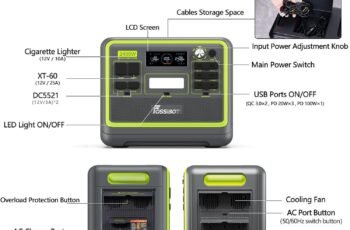
The port layout adds to that flexibility. EcoFlow includes 7 outlets in total:
- 3 UPS AC outlets
- 2 USB-A ports
- 1 USB-C port
- 1 car output
That mix is practical because it lets us run household-style plugs and smaller personal devices at the same time without extra adapters. For many buyers, that’s the real convenience: one box can handle a router, a phone, a laptop, and a small accessory together.
Expandability is where the product gets more interesting than many entry-level rivals. The battery can be increased with either the EB300 or EB600 to reach the stated 858Wh maximum. EcoFlow says the attachment uses Pogo Pin technology for a wireless-style connection that is meant to make upgrading easier. There’s also an added benefit with the extra battery route: EcoFlow notes that the add-on battery provides an extra 140W USB-C port, which gives users more charging options as their setup grows.
If we were advising a buyer step by step, the best approach would be this:
- List the devices you want to power most often.
- Check which ones rely on AC versus USB or car output.
- Estimate whether your use is occasional and light, or frequent and extended.
- Start with the base unit only if your loads are modest.
- Choose expansion later if overnight or longer off-grid sessions become routine.
That staged approach makes more sense than overbuying on day one.
Run Time and Noise Levels: How Long Can It Last?
Runtime is where expectations need to stay realistic. EcoFlow states up to 16 hours of runtime for devices under 100W, and that figure tells us exactly how the unit is meant to be used. Think low-draw gear such as lights, routers, or similar electronics. That can be very useful in practice. A router during an outage, for example, often matters more than powering a larger appliance for a short burst.
Verified purchasers frequently point to battery endurance on lighter loads as one of the reasons they like this model. The positive pattern is not that it performs miracles, but that it handles typical portable-power tasks well when users stay within sensible limits. That’s an important difference. A 286Wh station is not trying to be a large home backup battery; it is trying to provide dependable small-scale power.
Noise is another overlooked strength. EcoFlow lists the unit at 30 dB, even at a distance of 0.5 m. That’s a strong result for camping, desk use, van setups, or bedroom backup. A loud power station gets annoying fast, especially overnight. Quiet operation is one of those features people don’t always shop for first but appreciate every time they use it.
To stretch runtime as far as possible, we’d recommend three simple steps:
- Prioritize low-watt devices first. Reserve AC output for what truly needs it.
- Use USB ports when possible. Direct charging is often more efficient than plugging small electronics into AC chargers.
- Rotate devices instead of running everything at once. Charging one laptop and one phone sequentially can preserve useful reserve power.
If your goal is overnight internet, lighting, and phone charging, the unit makes good sense. If your plan involves long continuous appliance use, you’ll run into the limits of the base battery much faster.

Pro-Grade UPS and Safety Features: Protecting Your Devices During Outages
One of the most valuable features here has nothing to do with camping. The RIVER Plus includes a 10 ms auto-switch UPS, and that puts it in a different conversation from many casual-use power stations. For shoppers with desktop PCs, modems, routers, or NAS units, that rapid switchover can help bridge short outages and reduce the disruption that causes crashes or interrupted work.
EcoFlow adds several layers of visibility around that backup role. The unit uses LED indicators, plus app and software alerts, so users can track power status and respond before a problem becomes urgent. That matters because a backup system is only helpful if we understand what it is doing. Status feedback is part of the product’s usability, not just a bonus feature.
The most practical extra protection is EcoFlow’s mention of automatic data-saving support for PCs and NAS devices when low battery is detected. For people who work from home or store important files locally, that feature can be more valuable than another port or a slightly larger display. It addresses the real-world problem of not being present when battery levels begin to drop.
Here’s how we’d set it up for home backup use:
- Plug only essential electronics into the UPS AC outlets.
- Install the companion app or software right away.
- Test a brief unplug scenario to confirm the switch behavior.
- Set device-level save or shutdown preferences if your computer or NAS supports them.
- Keep nonessential accessories off the system so reserve power lasts longer during an outage.
For buyers who need both portable power and basic outage protection, this UPS function is one of the strongest reasons to shortlist it.
Fast, Safe Charging Strategies: Using X-Stream and Solar Power
Charging speed is a major selling point, and EcoFlow clearly leans on it. The company says the unit can go from 0 to 100% in hour with X-Stream charging. In a category where some compact stations still need several hours to refill, that’s a real convenience advantage. It means less waiting between uses and a better chance of topping off quickly before leaving for a trip or before a forecasted storm arrives.
Solar support broadens the appeal. EcoFlow lists up to 220W solar input and says recharge time can be as fast as 1.5 hours under suitable conditions. That’s attractive for campers and RV users who want renewable charging rather than depending only on wall power. As always with solar, real speed depends on panel quality, angle, weather, and sun strength, so buyers should treat the best-case figure as an ideal scenario rather than a guaranteed daily result.
The phrase that matters most in the charging description is that fast charging works with no damage, according to EcoFlow. Since battery health is a common concern, especially with frequent quick charging, that reassurance is part of the value proposition.
To charge efficiently without unnecessary stress, we’d suggest:
- Use wall charging when turnaround time matters most.
- Use solar when you have steady daylight and time flexibility.
- Avoid placing the unit in hot enclosed spaces while charging.
- Recharge after use rather than storing it empty.
- Match your solar expectations to weather reality. Fast solar figures depend on favorable conditions.
For many buyers, this rapid recharge ability will be one of the most noticeable day-to-day advantages of choosing the EF EcoFlow RIVER Plus Portable Power Station over slower compact competitors.

Customer Feedback Analysis: What Real Buyers Are Saying
The broad buyer response is encouraging. With more than 2,300 ratings and an average of 4.5 out of stars, the EF EcoFlow RIVER Plus Portable Power Station has the kind of review profile that suggests consistent satisfaction rather than a short burst of launch enthusiasm. Large review counts matter because they usually smooth out extremes. A product can fluke a high score with a small sample; holding 4.5/5 across thousands of purchases is harder.
Customer reviews indicate a few recurring strengths. Portability comes up often, which fits the compact focus of the design. Buyers also tend to appreciate the fast recharge time, especially compared with older power stations that spend much of the day plugged in. Multiple outlet types are another repeated positive because they reduce the need to carry extra adapters. Expansion support also seems to appeal to shoppers who want to start small but leave room for future use.
Concerns are more predictable than alarming. Some users see the product as expensive for the starting capacity, which is a fair point in this class. Others may feel the unit is still larger than expected if they are coming from simple battery packs instead of true power stations. On products with app and software functions, there are often occasional buyer complaints about setup or interface preferences, and that category of concern is worth watching even if it doesn’t define the overall ownership experience here.
What stands out most is that the review profile suggests reliability for real everyday tasks. Buyers are not treating it as a novelty item. They seem to be using it for home networking gear, travel electronics, and portable backup jobs where stable power and quick recharge matter more than raw battery size alone.
Who Is It For? Ideal Users and Use Cases
This model makes the most sense for buyers who need reliable small-to-medium portable power, not maximum capacity at any size or cost. Campers are a natural fit because the combination of quiet running, mixed outlets, and fast recharge is useful when power access is limited and setup time matters. If your trips involve lighting, charging personal devices, and keeping a few comfort items running, the feature set lines up well.
RV owners are another strong audience, especially those who want a secondary power source instead of relying only on the main electrical system. A compact station like this can handle short-use electronics, charge devices away from the main cabin area, or serve as a backup for basic essentials. The built-in light and solar compatibility also fit that mobile lifestyle well.
Home users should not overlook it. The UPS feature gives the EF EcoFlow RIVER Plus Portable Power Station a practical role for routers, desktop setups, or NAS devices during outages. That makes it especially relevant for remote workers, students, or anyone whose internet and local storage matter during a brief power cut.
We’d break the best-fit users into three groups:
- Campers and outdoor users who need quiet, portable energy for lights, phones, and small electronics.
- RV travelers who want fast-recharging supplemental power without moving to a much larger station.
- Home office users who value UPS protection for network gear and computers.
If your priority is running high-draw appliances for long stretches, you’ll likely want a bigger class of unit. If your priority is convenience, flexibility, and short-form backup, this is much closer to the sweet spot.

Should You Consider the EF EcoFlow RIVER Plus Portable Power Station?
The short answer is yes, provided your needs match its strengths. The EF EcoFlow RIVER Plus Portable Power Station combines a useful set of features that don’t often appear together in smaller units: quick recharging, quiet operation, UPS protection, a good mix of ports, and a clear path to more capacity later. That combination is why it stands out in a crowded category.
Our overall take is straightforward. This is not the power station for everyone, but it appears to be a very good one for buyers who want a compact model that can do more than charge phones. The strong review profile, practical UPS function, and recharge speed make it particularly appealing for campers, RV users, and home-office backup shoppers. If that sounds like your use case, this EcoFlow is well worth a close look.
Pros and Cons
Pros
- 4.5 out of stars from over 2,300 customer reviews suggests strong buyer satisfaction
- 286Wh LFP battery offers safer chemistry and better long-term durability than many older battery types
- 600W steady output with up to 1200W via X-Boost covers a wide range of small appliances and electronics
- Seven outlets, including AC, USB-A, USB-C, and car output, make it flexible for mixed-device charging
- 0 to 100% recharge in hour is unusually fast for this capacity class
- Expandable to 858Wh with EB300 or EB600 batteries gives it more room to grow
- 10 ms UPS support adds real backup value for home office and network gear
- 30 dB noise level is well suited to tents, vans, bedrooms, or desks
Cons
- Base capacity of 286Wh is modest if you want to run larger devices for long periods
- Expandability is useful, but extra batteries add to the total cost and carry load
- Rated power is 600W steady, so it is not the best pick for sustained heavy appliance use
- Some buyers looking for ultra-light travel power may still find the form factor bulkier than a simple battery pack
Final Verdict
Key Takeaways
- The EF EcoFlow RIVER Plus Portable Power Station pairs a 286Wh LFP battery with 600W steady output and up to 1200W through X-Boost.
- Its strongest features are 1-hour X-Stream charging, dB quiet operation, ms UPS support, and expansion up to 858Wh.
- A 4.5/5 rating from more than 2,300 reviews suggests buyers are largely happy with portability, charging speed, and overall usability.
- It is best suited to camping, RV travel, routers, laptops, and other light-to-medium loads rather than long heavy appliance use.
- Value looks strong for a premium compact power station, though the live price needs to replace the current £0.00 placeholder before shoppers can judge cost precisely.
Frequently Asked Questions
Is the EF EcoFlow RIVER Plus Portable Power Station worth buying?
Yes, for the right jobs. The EF EcoFlow RIVER Plus Portable Power Station offers a 286Wh LFP battery, 600W steady output, and up to 1200W with X-Boost, which makes it a practical fit for camping, router backup, lights, laptops, and many small appliances. With a 4.5 out of 5-star rating from more than 2,300 reviews, it has the kind of broad buyer approval that usually points to solid everyday usability.
How long does the EF EcoFlow RIVER Plus Portable Power Station last?
It depends on the device load. EcoFlow states up to hours for devices under 100W, which lines up best with low-draw gear such as lights and Wi-Fi routers rather than power-hungry appliances. If you need longer runtime, the unit can be expanded to 858Wh with the EB300 or EB600 extra battery options.
Can the EF EcoFlow RIVER Plus Portable Power Station be used as a UPS?
It can handle many sensitive electronics because it includes a pro-grade UPS function with a ms auto-switch. That feature is designed to keep devices like PCs and NAS systems protected during brief outages, and the alerts through the LED display, app, and software help users react quickly if battery levels drop.
How fast does the EF EcoFlow RIVER Plus Portable Power Station charge?
EcoFlow says the unit can recharge from to 100% in hour using X-Stream charging. It also supports up to 220W solar input, with a quoted solar recharge time as fast as 1.5 hours in suitable conditions. In daily use, wall charging is the more predictable option, while solar speed will vary with panel setup and weather.