Ad Blocker Detected
Our website is made possible by displaying online advertisements to our visitors. Please consider supporting us by disabling your ad blocker.
Have we ever wished we could bring mains-level power with us wherever we go—without the noise, fumes, and hassle of a generator?
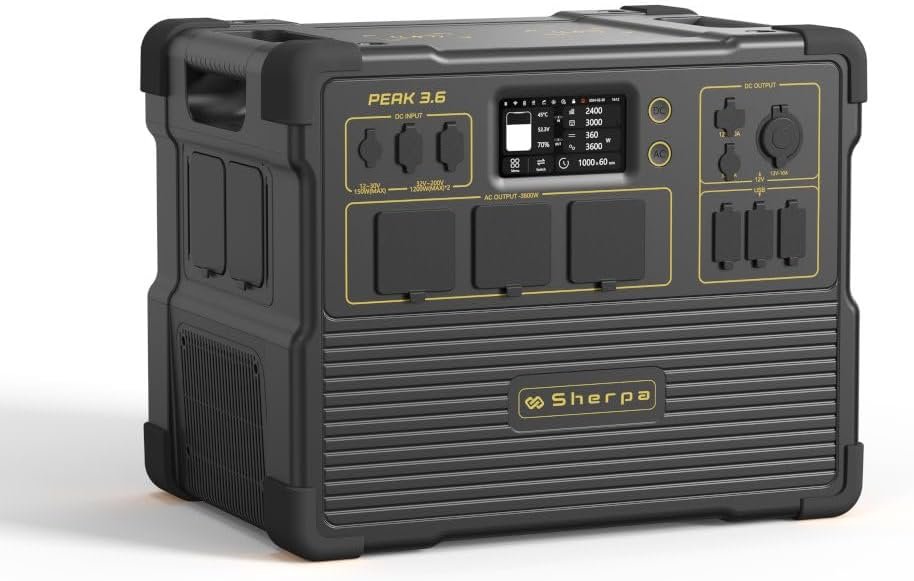

What Is the Sherpa PEAK 3.6 Portable Power Station?
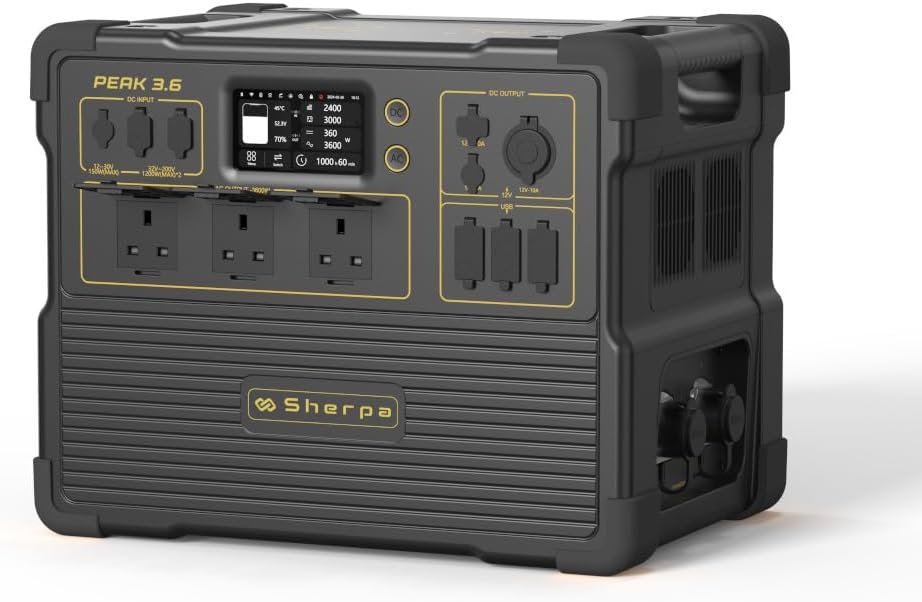
The Sherpa PEAK 3.6 is a high-capacity portable power station designed for the UK, built around automotive‑grade LiFePO4 batteries. It gives us 3072Wh of energy and up to 3600W AC output, which is enough to run serious household appliances, tools, and off‑grid setups.
Instead of a petrol generator, we get clean, quiet, plug‑and‑play power with fast recharging, app control, and a solid 5‑year warranty. It is clearly aimed at those of us who need more than just a few USB ports and a lantern.
Key Specifications at a Glance
Sometimes it helps to see the essentials in one place. We can use this as our quick reference when comparing with other power stations or thinking through our use cases.
| Feature | Specification |
|---|---|
| Battery Type | LiFePO4 (EV‑grade, automotive-grade cells) |
| Battery Capacity | 3072Wh |
| Battery Lifespan | 3500+ cycles to 80% (daily 100–0% for ~10+ years) |
| AC Output (Continuous) | 3600W pure sine wave |
| AC Surge Output | 7000W |
| AC Sockets | 3 × 220–240V, 50Hz (UK compatible) |
| DC Outputs | 4 × USB‑A (18W), 2 × USB‑C (100W & 18W), XT60 12V–30A, Car Port 12V–10A, DC 5525 12V–5A |
| Wireless Charging | 2 × 15W wireless pads |
| Max DC Output (XT60) | 30A / 360W max |
| Recharge (AC) | 0–100% in ~1.7 hours (max 1850W input) |
| Recharge (Solar/DC) | 0–100% in ~1.4 hours (max 2400W input) |
| Vehicle Charging (optional) | ~6 hours with Charge‑500 fast charger (sold separately) |
| Expandability | Up to 4 × Sherpa Peak 3.0-EB (up to 15,360Wh total) |
| Connectivity | Touchscreen + Bluetooth/Wi‑Fi app control (iOS & Android) |
| Noise Level | ~45 dB (at <1 metre)< />d> |
| Weight | ~36 kg |
| Dimensions | 44.5 × 30.7 × 30.5 cm |
| UPS Function | 8–20 ms transfer time |
| Warranty | 5 years + UK‑based support and lifetime product support |
This list shows us that the Sherpa PEAK 3.6 is not just a “big battery bank”; it is a full‑featured, expandable system designed for serious power users.
Battery Technology: Why LiFePO4 Matters
When we invest in a power station of this size, we are really investing in the battery technology at its core. The Sherpa PEAK 3.6 uses LiFePO4 cells, which are often found in EVs and high-end energy storage systems.
Longevity: 3500+ Cycles and 10+ Years of Daily Use
The manufacturer rates the battery at 3500+ full cycles before capacity drops to about 80%. That is based on daily use from 100% to 0%, which is quite demanding.
In practical terms, if we fully cycle it once per day:
- After ~10 years, we still have about 80% of the original 3072Wh capacity.
- At that point, it remains very usable for off‑grid power, backup, or mobile setups.
This kind of lifespan stands out compared with many portable stations using standard lithium‑ion or NMC cells, which often have far fewer cycles before noticeable degradation.
Safety and Stability of LiFePO4
LiFePO4 chemistry is known for:
- Higher thermal stability
- Reduced risk of thermal runaway
- Better performance in heavy cycling environments
For us, that means more peace of mind if we keep the unit indoors, in a van, or in a workshop where safety is critical.
Capacity and Real‑World Runtime (3072Wh)
The 3072Wh capacity is the heart of how useful this unit is day to day. We like to translate watt‑hours into real‑world scenarios because that is how we decide if it fits our needs.
Typical Appliance Runtime Estimates
Here is a rough idea of what 3072Wh can do in practical terms (assuming ~85–90% overall efficiency):
- Laptop (60W): 30–40 hours
- Smartphone (10–15Wh per charge): 150–250 charges
- Wi‑Fi router (15W): 150–170 hours
- 12V fridge (60W average): 35–40 hours
- CPAP machine (40W): 55–60 hours
- TV (120W): 20–22 hours
- Air fryer (1500W): About 1.5–1.8 hours of total use
- Kettle (2000–2500W): Several boils depending on volume
- Power tools (600–1200W intermittent): Multiple hours over the day
These are ballpark figures, but they show that 3kWh is more than enough for typical camping weekends, remote work, or as a core part of a home backup setup.
Expandable up to 15,360Wh
One of the major strengths is the ability to add up to four Sherpa Peak 3.0‑EB expansion batteries, reaching over 15,360Wh. That turns a powerful portable station into a real mini energy storage system.
For us, that means:
- Multi‑day off‑grid capability without constant recharging
- A solid foundation for solar‑powered cabins, vans, or garden offices
- Significantly extended backup duration during power cuts
We are not locked into the factory capacity; we can grow the system as our needs evolve.
AC Output: 3600W Continuous, 7000W Surge
The AC side is where the Sherpa PEAK 3.6 really stands out. We are not dealing with a modest power bank; this is full‑scale power delivery for demanding loads.
Running High‑Demand Appliances
With 3600W continuous and 7000W surge (pure sine wave), we can comfortably power:
- Electric kettles and toasters
- Microwaves
- Induction hobs (within rating)
- Power tools like mitre saws, drills, and compressors (check starting surges)
- Washing machines and some tumble dryers (depending on power rating)
- Electric heaters (preferably on lower settings to manage runtime)
The pure sine wave output is important for sensitive electronics such as:
- Laptops and PCs
- Audio gear
- Medical devices (check with manufacturers for specifics)
It gives us clean, stable current similar to a good household mains supply.
Multiple AC Sockets for Flexibility
With 3 × 220–240V AC outlets (50Hz), we can plug in multiple devices at once without dragging along power strips for basic setups. For more complex scenarios, we can still use a high‑quality extension where needed, while being mindful of the 3600W total output limit.
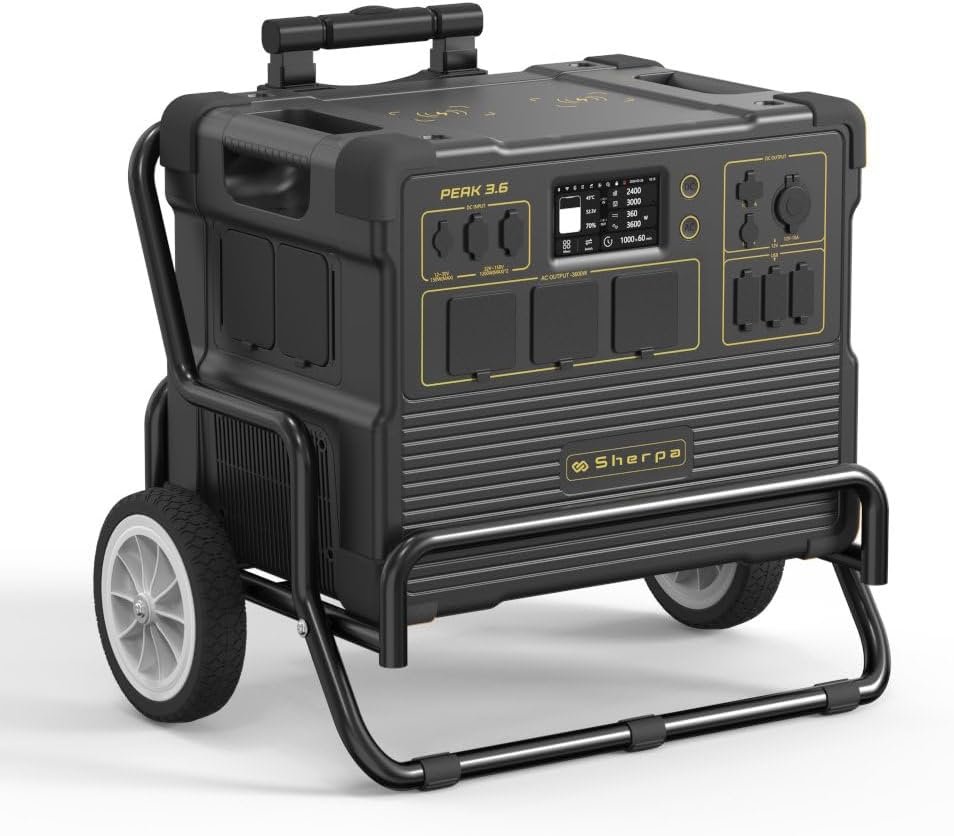

DC Output: Versatile Ports for Modern Devices
While AC gets most of the attention, the DC outputs are where a lot of efficiency gains happen. The Sherpa PEAK 3.6 includes a generous set of DC ports so we can charge and run smaller devices without going through the inverter.
USB‑A and USB‑C for Everyday Tech
We get:
- 4 × USB‑A (18W): Ideal for phones, tablets, cameras, small gadgets
- 2 × USB‑C (one 100W, one 18W): Great for laptops, newer tablets, and fast‑charging phones
This allows us to:
- Charge a laptop at full speed via the 100W USB‑C
- Keep multiple phones, tablets, and accessories topped up simultaneously
- Reduce the need for bulky laptop bricks or multi‑port chargers
Using DC directly can be more efficient than using AC adapters, helping us squeeze a bit more runtime out of the same capacity.
High‑Current DC (XT60, Car Port, and Barrel Outputs)
Further DC options include:
- XT60 12V–30A (up to 360W Max): Ideal for higher‑draw 12V loads such as fridges, diesel heaters, or dedicated 12V setups
- 12V Car Port 10A: For standard car accessories and coolers
- DC 5525 12V–5A: For compatible routers, monitors, or DC‑powered gear
This combination allows us to create a pretty comprehensive 12V ecosystem around the Sherpa PEAK 3.6 without needing multiple separate power sources.
Wireless Charging Pads for Convenience
The 2 × 15W wireless charging pads are great for:
- Smartphones that support Qi wireless charging
- Wireless earbuds cases
We simply drop the phone on top and let it charge—perfect when we are cooking, working, or relaxing around camp, without hunting for cables.
Fast Recharging: AC, Solar, and Vehicle Options
Recharge speed is critical. A large capacity is only as useful as how quickly we can refill it. The Sherpa PEAK 3.6 performs strongly here.
AC Charging: 0–100% in About 1.7 Hours
With up to 1850W AC input, we can go from empty to full in approximately 1.7 hours. That is very quick for a 3072Wh unit.
For us, this means:
- We can plug in between jobs or in the evening and be ready again next morning.
- During a power cut, we can recharge rapidly when mains comes back on, maximizing preparedness.
- For van life or off‑grid cabins near a mains connection, we have fast turnaround.
We do not have to leave it plugged in overnight simply to ensure a full charge.
Solar/DC Charging: 0–100% in About 1.4 Hours
With up to 2400W solar/DC input, we can theoretically recharge even faster via solar panels or a high‑power DC source. In real life, actual charge times will depend on:
- Panel wattage
- Orientation and tilt
- Weather and time of year
Still, having 2400W of potential solar input means:
- We could recharge from a big solar array in a relatively short sunny window.
- Off‑grid installations can rely much more heavily on solar as a primary charging method.
We just need to ensure our solar setup is designed around the input specs and connectors of the Sherpa PEAK 3.6.
Vehicle Charging: Around 6 Hours with Optional Fast Charger
Using the optional Charge‑500 fast charger (sold separately), we can recharge from a vehicle in about 6 hours. For long road trips, remote filming, or mobile workshops, this is a useful backup.
We only need to remember that frequent high‑power charging from the vehicle will also impact the vehicle’s alternator and battery system, so installation should be done thoughtfully.
Portability and Build: Weight, Size, and Durability
A 3kWh, 3.6kW power station is never going to be feather‑light, but the Sherpa PEAK 3.6 aims to balance portability and capacity.
Physical Size and Weight
- Weight: 36 kg
- Dimensions: 44.5cm (L) × 30.7cm (W) × 30.5cm (H)
This is manageable for two‑handed lifting and short moves (house to garden, van to campsite), but not something we casually carry long distances. For us, it suits:
- Campervans and motorhomes
- Workshops, garages, sheds
- Garden offices or off‑grid cabins
- Events, markets, and outdoor work sites
If we plan to move it often, using a trolley, dolly, or built‑in handles (if provided) will make life easier and protect our back.
Shockproof Construction and Low Noise
Being shockproof means it is designed to handle bumps and knocks that come with real‑world use. At around 45 dB at less than 1 metre, the operation noise is similar to a quiet conversation or a modern fridge.
This is very different from a petrol generator, which is often loud enough to disturb neighbours or campsite users. With the Sherpa PEAK 3.6, we can work, sleep, or relax near it without significant noise annoyance.
User Interface and Smart App Control
A powerful system is only as pleasant to use as its interface allows. Here, the Sherpa PEAK 3.6 leans into modern controls.
Real‑Time Touchscreen
The integrated touchscreen provides:
- Live readouts of input and output power
- Remaining runtime or charge percentage
- System status and warnings
- Access to settings and preferences
We can see at a glance what is happening, which devices are drawing power, and how long our current usage pattern can be sustained.
Bluetooth and Wi‑Fi App (iOS & Android)
Remote monitoring and control via the app offer several advantages:
- We can check status and control outputs from another room or from inside the van.
- We can monitor charging progress without standing next to the unit.
- Firmware updates may be pushed through the app, improving performance or adding features (depending on manufacturer support).
This turns the Sherpa PEAK 3.6 into more of a smart energy hub than a simple power box.
UPS Function: Backup Power in 8–20 ms
For many of us, a key use case is home or office backup. The built‑in UPS (Uninterruptible Power Supply) function is a big plus.
How the UPS Mode Helps
With an 8–20 ms transfer time, the unit can:
- Keep critical devices like PCs, routers, and networking gear running during short outages.
- Maintain power to home office setups so we do not lose work.
- Support essential electronics during longer blackouts, depending on load.
Most desktops and many electronics can handle a brief transfer window in this range without shutting down, especially if their power supplies have modest internal capacitors.
We simply need to connect the Sherpa PEAK 3.6 into our system in line with the manufacturer’s instructions for UPS use.
Use Cases: Where the Sherpa PEAK 3.6 Shines
The specs are impressive, but where does this product genuinely fit into our lives? Let us look at some real scenarios.
Home Backup During Power Cuts
For home backup in the UK, we can use the Sherpa PEAK 3.6 to:
- Run lights, routers, phones, and laptops easily for many hours.
- Keep a fridge and/or freezer running to protect food.
- Power lower‑wattage heaters, fans, or electric blankets (with careful management).
- Maintain workstations and entertainment devices.
If we add expansion batteries, we can support more circuits or run longer. It is not intended to replace a whole‑house generator for every scenario, but it can carry us through common outages with minimal disruption.
Campervan, Motorhome, and Off‑Grid Camping
For mobile setups, we get:
- Enough power to run a 12V fridge, diesel heater, lights, and electronics comfortably.
- The ability to cook with induction hobs, air fryers, or kettles without gas (within runtime limits).
- Fast solar recharging to support genuine off‑grid living if we combine it with a robust solar array.
We can leave the lead‑acid leisure batteries behind or use this unit as the central hub of a modern electrical system.
Remote Worksites and Tools
On worksites or remote locations:
- 3600W AC can feed many power tools, chargers, and lighting rigs.
- The 7000W surge capability helps start heavier tools with inrush currents.
- DC ports can power LEDs, routers, or communication devices.
This is particularly useful for tradespeople, event organisers, or content creators working in fields, gardens, or in buildings without safe or reliable mains access.
Photography, Filmmaking, and Events
For creative professionals:
- We can power lights, cameras, monitors, and laptops all day.
- AC and DC ports allow us to mix small and large gear on one central source.
- The low noise floor is ideal for audio recording environments.
If we pair the Sherpa PEAK 3.6 with a suitable solar kit, we can effectively create a pop‑up studio almost anywhere.
Efficiency and Practical Power Management
Owning a large power station is partly about learning how to use it intelligently. The Sherpa PEAK 3.6 gives us enough headroom that we do not have to micromanage every watt, but some awareness goes a long way.
Balancing AC and DC Loads
Because inverting DC battery power to AC always incurs some losses, we can:
- Prefer DC ports for phones, tablets, routers, and 12V fridges.
- Reserve AC for larger appliances or devices without DC options.
Over time, small gains in efficiency mean more hours of usage from the same charge.
Understanding Load Priorities
We might want to decide in advance:
- What we must power (e.g., CPAP, fridge, router).
- What is nice to have (TV, kettle, gaming laptop).
- What we use sparingly (high‑wattage heaters, power‑hungry tools).
Using the touchscreen or app, we can monitor total draw and keep it within sensible limits, making sure we always have sufficient capacity for essentials.
Warranty, Support, and Long‑Term Value
When we are spending at this level, we naturally think about long‑term value, reliability, and support.
5‑Year Warranty and Lifetime Product Support
The Sherpa PEAK 3.6 comes with:
- A 5‑year warranty
- UK‑based support and repair coverage
- Lifetime product support
For us, that indicates confidence in the build quality and battery durability. The fact that support is UK‑based also simplifies turnaround times and communication compared with some imported systems without local presence.
Cost vs Lifespan
Because of the LiFePO4 chemistry and 3500+ cycle rating:
- Our cost per cycle can be significantly lower than cheaper, shorter‑lived units.
- Over a decade of use, the initial investment spreads out quite reasonably.
We are buying a long‑term tool rather than a consumable gadget, which can make sense if we frequently rely on portable or backup power.
Pros and Cons of the Sherpa PEAK 3.6
It helps to summarise what we gain and what we might need to compromise on when choosing this unit.
What We Like
- High Capacity (3072Wh): Enough for serious uses, from home backup to off‑grid living.
- Strong Output (3600W / 7000W surge): Capable of running many household and professional devices.
- Durable LiFePO4 Battery: 3500+ cycles, long lifespan, and safer chemistry.
- Versatile Ports: Multiple AC outlets, broad DC selection, USB‑C 100W, and wireless pads.
- Fast Charging: 1.7 hours via AC, 1.4 hours via solar/DC (with suitable setup).
- Expandable: Up to 15,360Wh with Sherpa Peak 3.0‑EB expansion packs.
- Smart Control: Touchscreen plus Bluetooth/Wi‑Fi app for remote monitoring.
- Quiet Operation (~45 dB): Friendly to home, campsite, and studio environments.
- UPS Function (8–20 ms): Useful for protecting computers and key electronics from power cuts.
- Robust Warranty and UK Support: 5‑year coverage and lifetime support for peace of mind.
Potential Drawbacks
- Weight (36 kg): Not a grab‑and‑go device; better suited for semi‑fixed or wheeled setups.
- Upfront Cost: High‑end specs and LiFePO4 come with a higher purchase price (though offset by longevity).
- Max DC Output (30A/360W): Sufficient for most 12V loads, but very specialised high‑draw 12V setups may need careful design.
- Solar Setup Required: To fully benefit from fast solar charging, we need a sizeable and well‑matched solar array.
None of these are flaws so much as natural trade‑offs for a powerful, long‑life portable system.
Comparison With Smaller Portable Power Stations
We might wonder if we really need something this powerful when smaller, lighter stations exist.
Where Smaller Units Fall Short
Most compact power stations:
- Have capacity in the 500–1000Wh range.
- Offer AC output well below 1000–1500W.
- Use battery chemistries with fewer cycles and shorter lifespans.
That is fine for:
- Charging phones and laptops
- Running small lights
- Occasionally powering a small appliance briefly
But they struggle or fail completely with:
- Electric kettles, induction hobs, microwaves
- Power tools with heavy startup currents
- Multi‑day off‑grid scenarios without frequent recharging
Why We Might Choose the Sherpa PEAK 3.6 Instead
If we:
- Want to treat this as a true backup power solution, not just a glorified power bank
- Need to run several appliances at once
- Plan long‑term off‑grid or semi‑off‑grid living
- Value a 10‑year+ usable lifespan
Then the Sherpa PEAK 3.6 gives us both capacity and durability that smaller units simply cannot match.
Everyday Experience: Living With the Sherpa PEAK 3.6
Technical specs only tell part of the story; usability day to day is just as important.
Setup and First Use
Set‑up is usually straightforward:
- Unpack the unit and ensure adequate ventilation around it.
- Charge it fully via AC (or solar if available) before the first use.
- Connect our devices via AC or DC ports as needed.
- Use the touchscreen to check status and settings.
- Pair the app via Bluetooth/Wi‑Fi for remote use.
We get an immediate sense of how much power devices are drawing, and we quickly learn what combinations are sustainable over different time spans.
Integration Into Our Routine
Over time, we might:
- Keep it partially or fully charged as a standby UPS for home office and networking gear.
- Use it as the main power source for a van or tiny home.
- Bring it out for garden parties, film shoots, or markets where we need silent and reliable electricity.
Because of the fast charging, it is much less stressful to top up before an event or after a heavy‑use day; we do not have to plan a full overnight charge.
Solar‑Ready: Building an Off‑Grid System Around It
For many of us, solar compatibility is a crucial feature. The Sherpa PEAK 3.6 is clearly set up for serious solar input.
Designing a Solar Setup
To get close to that 2400W DC input potential, we would look at:
- The total wattage of our solar panels (e.g., multiple 300–400W panels)
- How they are wired (series/parallel combinations to match voltage and current requirements)
- Charge controller and connectivity (in line with manufacturer guidance)
Even with a smaller array (say 600–1000W), we can significantly offset our daily usage during sunny periods.
Realistic Off‑Grid Expectation
With a well‑sized solar system:
- We could run many daily essentials without depleting the battery fully.
- In summer, we may remain effectively net‑zero for moderate loads.
- In winter or cloudy conditions, we would still need to manage usage and possibly use AC or vehicle charging.
The key point is that the Sherpa PEAK 3.6 is ready to be at the centre of such a setup, not just a side device.
Who Is the Sherpa PEAK 3.6 Best Suited For?
Not all users need this level of capability, but for the right person or team, it can be a game‑changer.
Ideal Users
We see strong benefits for:
- Homeowners who want a robust, quiet backup power solution, especially those in areas with unreliable grids.
- Van lifers and motorhome owners who want to reduce or eliminate gas reliance and enjoy powerful electric cooking and heating options.
- Tradespeople and contractors working on temporary or remote sites without reliable mains.
- Photographers, filmmakers, and event organisers who need stable, silent power for gear in varied locations.
- Small business owners who want UPS‑style protection and backup power without installing a full fixed battery system.
Less Ideal for Some
It might be overkill if we:
- Only need to charge phones and a laptop occasionally.
- Want something ultra‑lightweight to carry long distances by hand or on foot.
- Have no interest in using high‑wattage AC appliances or solar expansion.
In those cases, a smaller, lighter power station may be more practical and economical.
Final Thoughts: Is the Sherpa PEAK 3.6 Worth It?
If we are serious about portable or backup power, the Sherpa PEAK 3.6 – Portable Power Station UK (3072Wh @ AC 3600W), LiFePO4 (EV Grade Cells)-3500 cycles, Multiple DC Outlets (30A/360W Max), Fast Charging (AC‑1.8h /DC‑1.4h)/Solar ready, 5‑YEAR Warranty offers a compelling blend of capacity, output, durability, and usability.
We get:
- A large, long‑life LiFePO4 battery
- High continuous and surge AC power for demanding gear
- Versatile DC ports and wireless charging for modern devices
- Very fast recharge times on AC and solar/DC
- Expandability for much larger off‑grid systems
- A usable UPS mode for home and office backup
- Quiet, shock‑resistant operation and a strong warranty with UK support
For households, van conversions, off‑grid cabins, workshops, and mobile professionals, this power station feels more like a compact energy system than a simple gadget. If we value long‑term reliability, flexibility, and high‑output performance, the Sherpa PEAK 3.6 stands out as a robust and future‑ready choice.
Disclosure: As an Amazon Associate, I earn from qualifying purchases.