Ad Blocker Detected
Our website is made possible by displaying online advertisements to our visitors. Please consider supporting us by disabling your ad blocker.
Disclosure: As an Amazon Associate, I earn from qualifying purchases.
Have we ever found ourselves halfway through a camping weekend, a work trip, or a power cut and thought, “Why is everything out of battery right when we need it most?”

What Is the Sherpa PEAK 0.6 Portable Power Station?
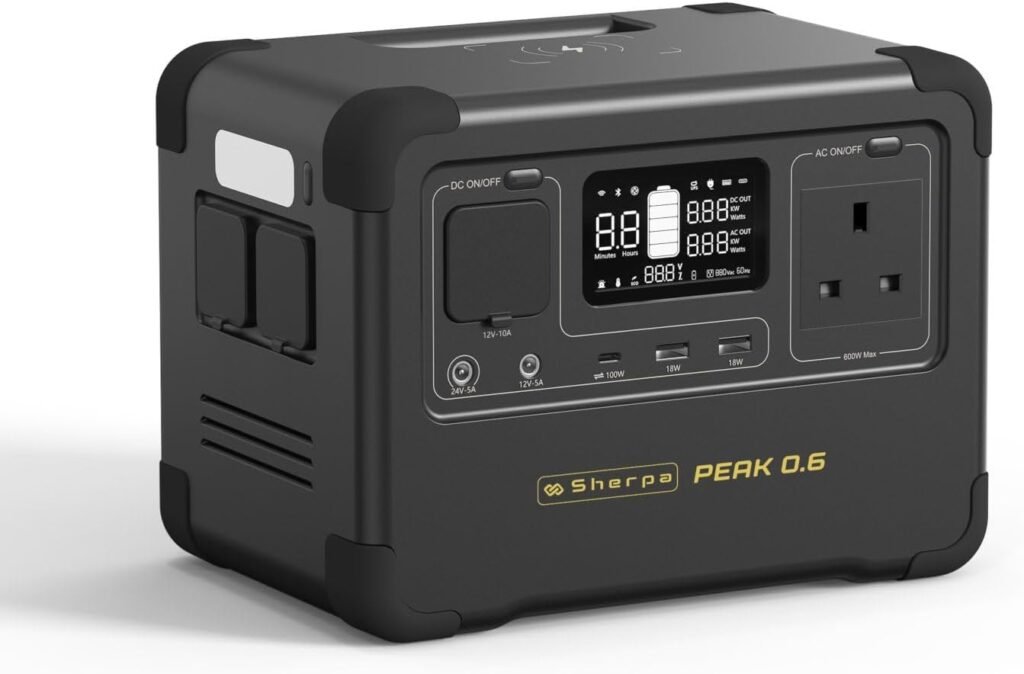
The Sherpa PEAK 0.6 is a compact, UK‑ready portable power station built around a 576Wh LiFePO4 battery and a 600W pure sine wave inverter. It is designed to power and charge laptops, phones, tablets, cameras, small appliances, and essential home gear during trips or outages.
We see it as a middle-ground solution: more capable than a simple power bank, but easier to carry and manage than a large, heavy home backup system. With multiple DC outlets, a fast AC input, and solar readiness, it’s positioned as an all-rounder for everyday and emergency use.
Key Specifications at a Glance
Before we go deeper into how this unit fits into real-world scenarios, it helps to see the essential specs side by side. This lets us quickly check whether it matches our needs for capacity, power, and portability.
| Feature | Specification |
|---|---|
| Battery Chemistry | LiFePO4 (EV Grade Cells) |
| Battery Capacity | 576Wh |
| Battery Lifespan | 3,500+ cycles to 80% capacity |
| AC Output (Continuous) | 600W (Pure Sine Wave) |
| AC Output (Surge) | 1,200W (short burst for startup loads) |
| AC Sockets | 1 x UK socket (220–240V, 50Hz) |
| DC Output | 10A total, 120W Max |
| USB-A Ports | 2 x USB-A |
| USB-C Port | 1 x bi-directional USB-C (input/output) |
| DC 5525 Ports | 2 x DC 5525 |
| Wireless Charging | 1 x Wireless Charging Pad |
| 12V Car / Aux Port | 1 x 12V car-style/aux port |
| AC Charging Speed | Up to 500W (about 1.5 hours from 0–100%) |
| DC/Solar Charging | Up to 2 x 100W (200W total, ~3 hours with good conditions when combined) |
| UPS Transfer Time | 8–20ms |
| Connectivity | App compatible via Bluetooth / Wi‑Fi |
| Weight | Approx. 6.75kg |
| Warranty | 5‑year warranty |
Build Quality and Design
The Sherpa PEAK 0.6 feels like it was built to be carried and moved often, not just parked in a corner. At around 6.75kg, it’s not feather-light, but it’s far more portable than many higher-capacity stations that quickly become awkward to move.
We appreciate that the casing feels robust enough for day-to-day knocks—car boots, campsite tables, and office floors—without coming across as overly rugged or industrial. For us, it hits that sweet spot where we’re comfortable using it indoors as part of a home office setup while still being confident taking it outside.
Portability and Everyday Handling
In terms of day-to-day usability, 6.75kg is manageable for most of us to carry with one hand for short distances. It’s easy to move between rooms, to the garden, to the car, or into a tent. We’d describe it as “grab-and-go” portable rather than “backpack for a hike” portable.
We see this as a unit that lives near the door, in the boot of a car, or in our office, ready to come along when we think we might need extra power, but without demanding a full reorganisation of our gear.
Layout of Ports and Controls
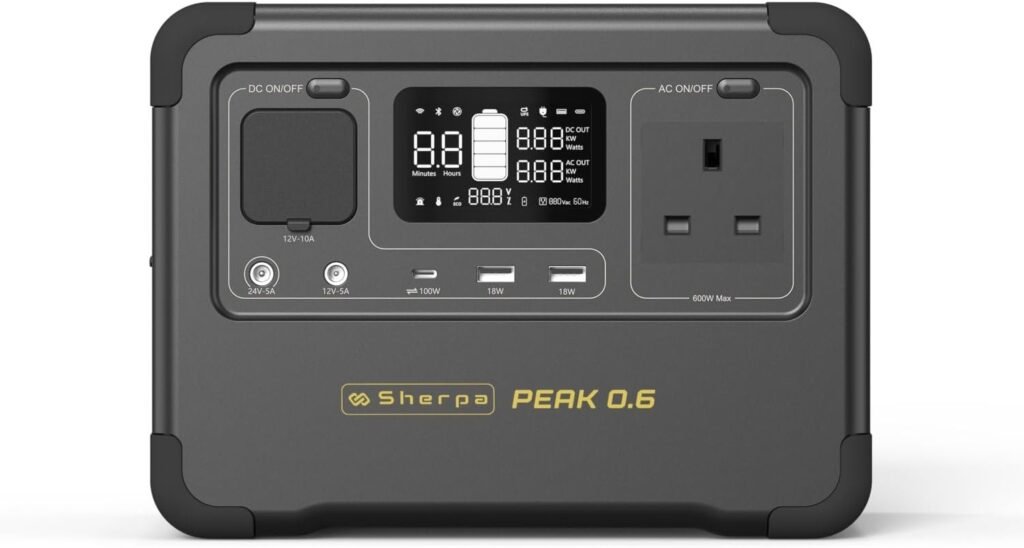
The port layout on the Sherpa PEAK 0.6 is intentionally practical. All the major ports sit on one main face, so we aren’t constantly spinning the unit around to find what we need.
Controls and ports are clearly labelled, which makes a difference when we are tired, in low light, or managing lots of cables:
- AC socket (UK, 220–240V, 50Hz)
- 2 x USB-A ports
- 1 x USB-C bi-directional port
- 2 x DC 5525 ports
- 1 x 12V car/aux port
- Wireless charging pad on top
We also like having the wireless charging pad on the top surface—that way, we can simply place our phone down rather than hunt for another cable.
Battery Technology and Lifespan
One of the biggest selling points is the use of LiFePO4 (Lithium Iron Phosphate) cells, the same chemistry widely used in EVs and higher-end power solutions. These batteries are known for long cycle life, thermal stability, and improved safety compared with many older lithium chemistries.
For us, this means the Sherpa PEAK 0.6 is not just a purchase for a single season; it is being positioned as a long-term companion for years of regular use.
576Wh Capacity in Real Terms
A 576Wh battery can sound abstract, so we like to think of it in everyday examples. Assuming modest real-world efficiency (inverter losses, etc.), we can roughly expect:
- Smartphone (10–12Wh per full charge): around 35–45 charges
- Laptop (50–60Wh battery): around 7–9 charges
- Tablet (30–40Wh): around 12–15 charges
- LED light (5–10W): 40–100 hours
- Wi‑Fi router (10–15W): 25–40 hours
- Portable mini-fridge (60W average): about 7–8 hours of continuous run
Actual runtimes will vary depending on how efficiently we use the power station and what else is plugged in, but this gives us a feel: it’s enough capacity for a weekend trip or to keep essential electronics going through an overnight power cut.
3,500+ Cycles to 80% Capacity
The rated lifespan of 3,500+ cycles to 80% of original capacity is significant. If we used the unit every single day and ran a full cycle each time (which is actually more than most of us would), we are looking at nearly ten years before the battery drops to 80% of its starting capacity.
In practical terms, for more typical use—weekends away, occasional outages, outdoor events, or backup office power—the battery should comfortably outlast many laptops and phones we use alongside it.

AC Output: 600W Continuous, 1,200W Surge
At the heart of any power station is the inverter, and this one offers 600W of continuous pure sine wave AC power with a 1,200W surge capacity. That means it can power most small appliances and sensitive electronics that we realistically want to run off a portable unit.
The pure sine wave output matters. It ensures compatibility with sensitive electronics like laptops, monitors, audio equipment, and CPAP machines, which do not react well to modified sine wave inverters.
What Can We Actually Power at 600W?
Here are some common loads that sit comfortably within the 600W continuous limit:
- Laptops and monitors
- Routers and network gear
- Camera chargers and battery chargers
- Game consoles and small TVs
- Small fans and LED lighting
- CPAP machines (depending on model)
- Low-wattage kitchen gadgets (like small blenders or mini coffee makers within rating)
Where we need to be more cautious is with high-draw appliances:
- Kettles, toasters, hairdryers, and electric heaters often exceed 1,000–2,000W and are not suited to a 600W inverter.
- Some tools (like certain drills or saws) might start within surge but not run comfortably within continuous consumption.
We like to treat 600W as suitable for “electronics and light appliances” rather than trying to run full-size kitchen gear or heating devices.
DC Output and Charging Options
Beyond AC power, the Sherpa PEAK 0.6 is equipped with a range of DC outputs that help us charge devices more efficiently. DC can often be more efficient than running everything through the inverter, which translates to better use of our 576Wh capacity.
DC Output: 10A, 120W Max
The DC section provides up to 10A total, capped at 120W. This is shared across the DC 5525 ports and the car/aux port, so we need to be aware of the combined load.
In practical terms, this is great for:
- Running 12V automotive-style devices (coolers, air compressors within rating)
- Powering certain routers or DC-powered monitors (when compatible)
- Charging cameras, lights, and radio equipment through dedicated DC cables
We get more efficient usage by keeping some gear on DC rather than turning on the AC inverter for everything.
USB-A and USB-C: Modern Device Charging
The inclusion of 2 x USB-A ports and 1 x bi-directional USB-C port gives us flexibility across older and newer devices:
- USB-A: Reliable for phones, tablets, Bluetooth speakers, earbuds, and older devices.
- USB-C (bi-directional): Acts as both an output and an input, which can charge modern laptops, tablets, and phones faster, and also allow us to recharge the station from a suitable USB-C adapter.
Having a powerful USB-C port can often replace the need to carry a separate laptop charger, which is especially useful when we try to keep a minimal travel kit.
Wireless Charging Pad
The wireless charging pad built into the top is one of those features that sounds minor but quickly becomes a favourite. When we get into camp or back to our desk, placing our phone on the top to charge feels natural and keeps the area tidier.
We see it as ideal for:
- Keeping our main phone topped up as we work or relax
- Charging a secondary phone, wireless earbuds, or other Qi-compatible devices without extra cables
It might not be as fast as a high-watt wired charger, but for convenience, it is excellent.
Fast Charging and Input Options
One of the standout capabilities of the Sherpa PEAK 0.6 is its charging speed. The ability to go from empty to full in about 1.5 hours via AC is genuinely useful when we are short on time and need the unit topped up before heading out.
We appreciate that the designers prioritised both speed and flexibility in how we refill the battery, because a power station is only as good as how quickly we can get it ready again.
AC Charging: Up to 500W
When plugged into the mains, the Sherpa PEAK 0.6 can accept up to 500W of input power. Under ideal conditions, this allows us to charge the unit from 0–100% in about 1.5 hours.
Some scenarios where this matters:
- Charging between meetings at the office
- Topping up at home in the short window between trips or errands
- Using a generator for a limited time but recharging the power station quickly to run quietly afterwards
We like that we can set aside a relatively short window and know we will get a full recharge, rather than having to leave it plugged in all day.
DC and Solar Charging: Combined Input
The unit supports DC input up to 2 x 100W (200W total), which is particularly useful with solar panels or car charging setups. When combined with AC input, we can reach a faster overall recharge time (around 3 hours with good conditions via solar/DC).
For solar users, this means:
- We can keep the station topped up during sunny days.
- We have the option to extend our off-grid time considerably.
- In high-usage situations, we can offset much of our daily power use with solar input.
We see this as a strong match for vanlife users, campers who stay in one place for a few days, or anyone who wants a quieter, cleaner alternative to running a fuel generator constantly.
UPS Function for Home and Office Backup
The built-in UPS (Uninterruptible Power Supply) function with an 8–20ms transfer time is a valuable addition, especially for those of us working from home or running small office setups. With UPS mode, we can keep the power station plugged into the mains and have it automatically take over if the grid power fails.
We find this particularly helpful when working on important tasks or when we have sensitive electronics that we don’t want abruptly shut down.
How the 8–20ms Transfer Time Helps
The 8–20ms switchover time is fast enough for many devices, such as:
- Desktop PCs and laptops (with power bricks)
- Wi‑Fi routers and network gear
- Monitors and small office electronics
Some very sensitive equipment might still detect the change, but for typical home and office use, this speed is generally sufficient to prevent shutdowns. It gives us peace of mind during storms, grid instability, or scheduled maintenance.
Using the Sherpa PEAK 0.6 as a Backup Hub
We can set up a small “resilience hub” around the power station:
- Connect our router, modem, and maybe a low-wattage lamp and monitor to the AC output.
- Keep the station plugged into the wall to maintain charge.
- When the power goes out, these essentials remain powered by the battery automatically.
This turns an ordinary workspace into something more robust without investing in a full-house UPS system.
Connectivity and App Control
The unit’s Bluetooth and Wi‑Fi compatibility opens the door to app-based monitoring and control. We see this as especially handy when the power station is tucked under a desk, in a corner, or outside connected to panels.
Being able to check status, input, and output without bending down or going outside makes the whole experience smoother.
What We Can Manage Through the App
While exact features depend on the app version, we generally expect:
- Live battery percentage and remaining runtime estimates
- Real-time input and output wattage
- On/off toggles for specific output sections (AC or DC)
- Firmware update options in some cases
For us, the main benefit lies in visibility. We can keep track of how our devices are using power and how quickly solar or AC is refilling the battery, which helps us plan better for long outings or outages.
Real-World Use Cases
A power station’s specs only tell half the story. What matters most is how it fits into our lives. The Sherpa PEAK 0.6 is versatile enough to serve as a travel companion, work backup, and emergency resource.
We have grouped some scenarios where this unit feels particularly strong.
Camping and Outdoor Adventures
For weekend camping trips, festival stays, or off-grid cabins, the Sherpa PEAK 0.6 has enough capacity to keep essentials powered without feeling like we brought a mini power plant.
We imagine typical usage might include:
- Charging phones, cameras, action cams, and lanterns
- Running a small fan in a tent
- Powering a portable fridge or cooler during the day
- Keeping a laptop going for evening movies or remote work
When paired with solar panels, we can stay out several days with a careful balance of charging and usage.
Road Trips and Vanlife
In a car, campervan, or motorhome, this unit slots naturally into daily life. It can recharge while we drive (via DC/solar or an AC inverter in the vehicle) and then serve as a silent, emission-free power source when we park.
We see benefits such as:
- Running a 12V fridge or cooler during stops
- Charging laptops and tablets for passengers
- Supporting a small mobile office from a scenic spot
- Acting as backup if the vehicle battery is under strain
We appreciate that it stays relatively compact while still offering enough capacity for meaningful off-grid time.
Home Office and Remote Work
For those of us working from home, the Sherpa PEAK 0.6 is a handy UPS and backup power source in one. By connecting a few key devices, we can keep working through most short-term outages.
A typical setup might cover:
- A laptop and one or two monitors
- A Wi‑Fi router and modem
- A small desk lamp or LED light
Even during extended outages, we could use it more sparingly, focusing on internet connectivity and occasional laptop charging rather than all-day heavy loads.
Emergency Preparedness and Power Cuts
In the UK, where storms or grid issues can cause regional outages, having a fully charged 576Wh station ready can make a real difference.
We can prioritise:
- Keeping phones charged for communication
- Running a radio or router
- Powering low-wattage lighting and potentially a CPAP machine (verify power needs)
- Charging power banks for neighbours or family
We cannot power the whole house, but we can keep critical items running. Combined with solar, we can extend that support across multiple days if needed.
Performance and Efficiency
How well a power station performs depends not just on core specs, but on how efficiently it handles real-world loads, conversion, and standby behaviour. With the Sherpa PEAK 0.6, we see thoughtful design geared towards making the most of its 576Wh capacity.
Pure Sine Wave Stability
The pure sine wave inverter is precise enough for sensitive electronics. Devices that rely on clean power—like some audio gear, medical devices, and certain chargers—benefit from this stability.
We can confidently run:
- High-end laptops and gaming machines (within watt limits)
- Audio interfaces, mixers, and powered monitors (within ratings)
- Sensitive lab or measurement tools that require consistent waveforms
We like having the reassurance that we are not risking our equipment just to get portable power.
Inverter and DC Efficiency
No inverter is 100% efficient, and we always lose a little energy turning DC battery power into AC. That is why we often prefer to use DC ports where available, especially for smaller electronics.
By prioritising USB and DC outputs over AC when possible, we can:
- Stretch runtime for longer trips
- Waste less energy as heat
- Keep the fan quieter in some scenarios
The combination of ports lets us tailor how we use the station to our own preferences.
Noise, Heat, and General Comfort
Even a well-built power station can be annoying if it whines loudly or gets excessively hot. The Sherpa PEAK 0.6 is designed to balance cooling needs with a reasonable noise profile.
We find that under light loads—charging phones or a laptop, for example—the fan may run quietly or intermittently. When we push the AC output near its upper limits, the fan naturally ramps up to maintain safe temperatures.
For home offices, living rooms, or tents, this balance is important:
- Under normal everyday loads, we expect the noise to be acceptable.
- Under heavy loads, we are trading some fan noise for safety and performance, which we consider a fair exchange.
As long as we are realistic about our load levels, we can position the unit where fan noise is least intrusive, such as under a desk or at the edge of a room.
Durability, Safety, and Warranty
Durability is where LiFePO4 chemistry and a solid warranty really make a difference. The Sherpa PEAK 0.6’s cell choice, cycle rating, and 5‑year warranty strongly suggest that the manufacturer expects this unit to see regular use.
We appreciate this combination, because it shifts the product from a “gadget” to more of an “infrastructure” piece—something we rely on consistently and expect to last.
Safety Benefits of LiFePO4
LiFePO4 batteries are well-regarded for:
- Lower risk of thermal runaway compared to some other lithium chemistries
- Better tolerance to higher cycle counts
- More predictable degradation over time
For us, using the unit indoors, in enclosed vehicles, or around family and colleagues, this added safety margin feels reassuring.
5‑Year Warranty and Long-Term Value
A 5‑year warranty is substantial in this product category. When paired with 3,500+ rated cycles, it indicates confidence in the underlying design and construction.
From a practical standpoint, if we plan to:
- Use the station weekly or daily for work
- Rely on it during frequent road trips
- Keep it as a dedicated home backup resource
We want to know that it is not likely to become unreliable within a short time. The warranty helps us justify the investment over several years of use.
Pros and Cons Summary
To put everything in perspective, we find it helpful to lay out the main strengths and a few limitations we should keep in mind.
What We Like
-
LiFePO4 battery with 3,500+ cycles
Long lifespan with safer chemistry and predictable performance. -
Fast AC charging (up to 500W)
Roughly 1.5 hours from empty to full saves time when we are in a hurry. -
Flexible DC and USB outputs
2 x USB-A, 1 x bi-directional USB-C, DC 5525 ports, car/aux port, and wireless pad cover almost all small devices. -
Pure sine wave 600W inverter
Safe for sensitive electronics and solid for everyday loads. -
UPS function with 8–20ms transfer
Useful for home office, routers, and small electronics during grid outages. -
App connectivity (Bluetooth/Wi‑Fi)
Remote monitoring and control increase usability. -
Solar ready
DC input supports up to 2 x 100W panels for off-grid or extended use. -
5‑year warranty
Strong backing for a portable power product.
What to Keep in Mind
-
Single AC socket
We may want a small extension or power strip to plug in multiple AC devices at once. -
600W limit unsuitable for large appliances
Kettles, heaters, hairdryers, and big power tools will exceed this unit’s safe range. -
Weight may be noticeable for some users
6.75kg is portable, but not something we would want to carry long distances on foot regularly. -
Fan noise under heavy load
As with most power stations, higher loads will cause more noticeable cooling noise.
Who Is the Sherpa PEAK 0.6 Best For?
To decide whether this power station fits us, it helps to think about our typical usage patterns and expectations. The Sherpa PEAK 0.6 is particularly well-suited for a few groups.
Ideal Users
-
Remote workers and home offices
Those of us who want UPS-like protection and portable backup to keep internet and computers running. -
Campers, festival-goers, and outdoor hobbyists
People needing reliable off-grid power for devices and light appliances over weekends. -
Vanlife and frequent road trippers
Travellers who want a compact but capable power hub that charges from the vehicle and supports life on the road. -
Preparedness-minded households
Families who want a clean, safe backup for short to moderate outages without dealing with fuel generators.
Maybe Not the Best Fit If…
- Our main goal is to power high-consumption appliances like electric kettles, ovens, or heaters.
- We need whole-home backup capacity; in that case, we would likely want a larger, heavier system or a fixed battery solution.
- We require ultra-lightweight solutions for hiking and minimalist backpacking; a smaller battery or power bank might be better for that use.
Practical Tips for Getting the Most Out of It
To maximise the value we get from the Sherpa PEAK 0.6, a few simple habits can go a long way. We like approaching it as a key part of our power setup rather than an emergency-only device.
Optimise Power Usage
-
Use DC outputs whenever possible
Charging phones, tablets, and some laptops through USB or DC is more efficient than using AC. -
Group high-watt tasks
If we need to run heavier AC loads, doing them in short, focused windows helps control heat and fan noise. -
Monitor via the app
Check which devices draw the most power and adjust our habits accordingly to stretch runtime.
Maintain Battery Health
-
Avoid leaving it at 0% for long periods
Try to recharge soon after heavy use to keep cells in good condition. -
Exercise the battery periodically
For an emergency-focused use case, we like to cycle it every few months: discharge to 20–30%, then recharge back to full. -
Store in a cool, dry place
Moderate temperatures and dry conditions are ideal for long-term health.
Build It Into Our Routine
- Keep it topped up near the door or in our office so it is always ready.
- Use it for day trips, garden gatherings, or as an extra “plug anywhere” resource.
- Treat it not just as backup, but as a convenience tool, which keeps us familiar with its operation and confident during an actual emergency.
Final Thoughts
The Sherpa PEAK 0.6 – Portable Power Station UK (576Wh @ AC 600W) with LiFePO4 cells and 3,500+ cycles offers a thoughtful balance between portability, capacity, and longevity. It’s compact enough to be carried easily, powerful enough to handle a wide range of electronics and light appliances, and robust enough to be a genuine long-term investment.
We see it fitting naturally into our lives as a multipurpose power partner: a steady presence in the home office, a reliable ally in the car or camper, and a quiet source of reassurance whenever the lights flicker. With fast charging, solar readiness, multiple DC outlets, UPS capability, and a 5‑year warranty, it stands out as a versatile and future-proof option for anyone who values reliable power wherever life takes us.