Ad Blocker Detected
Our website is made possible by displaying online advertisements to our visitors. Please consider supporting us by disabling your ad blocker.
Have we ever wished our favorite power bank could also run a mini fridge, power our laptop, and still be light enough to toss into a backpack without a second thought?

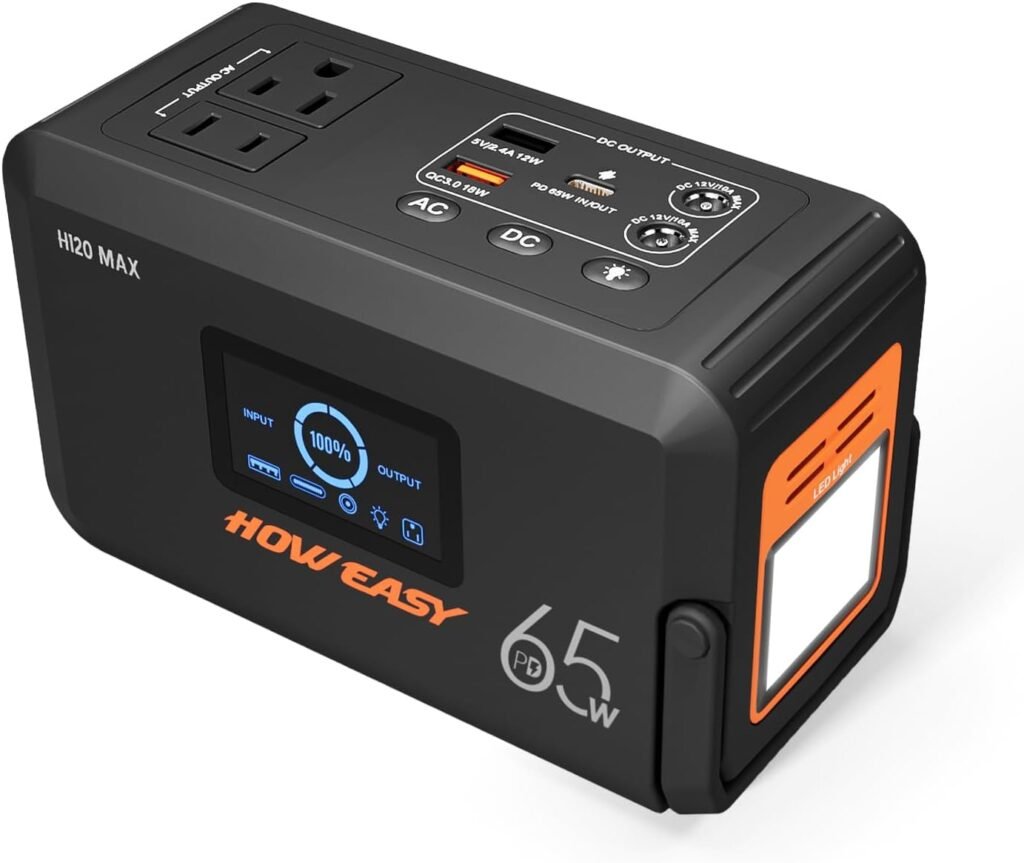
Understanding What the HOWEASY 98Wh Portable Power Station Actually Is
When we first look at the HOWEASY 98Wh Portable Power Station, it feels like a bridge between a power bank and a full-size power station. We are not lugging around a heavy battery box, yet we gain far more versatility than a standard USB power bank offers.
This compact unit gives us AC power, DC outputs, USB ports, and a solid LED flashlight in one small, travel-ready device. It is clearly designed for campers, travelers, and anyone who wants reliable backup power without carrying a bulky generator.
Key Specs at a Glance
Sometimes it helps to see the main numbers laid out. They give us an instant sense of whether this fits our needs or not.
| Feature | Specification / Detail |
|---|---|
| Battery Capacity | 98Wh (Lithium battery, FAA-compliant) |
| Weight | Approx. 2.2 lbs (1 kg) |
| Dimensions | 6.6 x 4 x 3 inches (compact and portable) |
| AC Output | 2 x 110V, 135W rated (200W peak) |
| USB-C PD Port | 1 x 65W PD (input/output, supports fast laptop charging) |
| USB-A Ports | 1 x QC3.0 fast charge, 1 x 5V/2.4A standard |
| DC Ports | 2 x DC outputs (for certain small devices and lights) |
| Charging Methods | 65W PD, wall adapter, car charger (12V), compatible solar input (15V–24V) |
| LED Light | 4 modes: Low, Medium, High, SOS |
| Protection System | 6-fold BMS: over-voltage, overload, over-current, overheating, short circuit, overcharge |
| Warranty and Support | 24-month warranty, 24/7 client service |
These specs immediately tell us what kind of expectations we should set. This is not meant to run power-hungry appliances like hair dryers or large microwaves, but it is powerful enough for phones, tablets, laptops, cameras, and some low-wattage devices.
Portability and Design: How Easy Is HOWEASY?
When we talk about a portable power station, we care about two things: weight and size. If it is too heavy or bulky, we end up leaving it at home.
The HOWEASY 98Wh unit checks the portability box. At about 2.2 pounds and with a compact footprint, we can slip it into a backpack, duffel, or even a larger purse. It feels more like carrying a chunky hardcover book than hauling a generator.
Build Quality and Durability
We want a portable power station that can handle everyday bumps, occasional drops, and changing temperatures. This model is built with a rugged outer shell and claims a weather-resistant design that withstands drops and extreme temperatures.
While it is not a fully waterproof device, the housing feels sturdy enough for typical camping and road trip use. We should still avoid leaving it directly in the rain or submerging it in water, but casual outdoor use feels well within its intended design.
Airline-Safe Capacity
One of the most underrated features here is the 98Wh capacity being compliant with FAA rules for carry-on lithium batteries (under 100Wh). That means we can pack this in our carry-on luggage without running into typical airline restrictions for larger power stations.
This makes it an appealing option for anyone who travels frequently and wants reliable AC and USB power on the go, whether we are working remotely or just want to keep devices topped off on long trips.

Power Capacity: What Can 98Wh Actually Do for Us?
Numbers like “98Wh” can sometimes feel abstract. To understand real-world performance, it helps to think in terms of the devices we use every day.
In simple terms, 98Wh (watt-hours) tells us how much total energy the battery can store. How long it can power something depends on that device’s power draw.
Example Use Cases and Approximate Run Times
These are rough estimates and can vary depending on specific device efficiency and conditions, but they help us picture what we can expect.
| Device / Use Case | Approximate Usage from Full Charge* |
|---|---|
| Smartphone (10–15Wh battery) | Around 5–8 full charges |
| Tablet (25–30Wh battery) | Around 2–3 full charges |
| Laptop (50–65Wh battery) | Roughly 1–1.5 charges (via PD, depending on model) |
| Camera / Drone batteries | Multiple recharges for small to mid-sized batteries |
| LED lantern or light (5W) | Around 15–18 hours |
| Mini fan (5–10W) | Roughly 8–16 hours |
| Very small mini fridge (40–60W)** | Around 1.5–2 hours (short-term cooling, not all-day use) |
| CPAP (low-power, via DC/AC)*** | Limited use, may handle part of a night depending on draw |
* These are general ballpark figures assuming some losses in conversion.
** Only for very low-power mini fridges; many standard fridges draw far too much.
*** Always confirm wattage and consult device requirements.
From this, we can see that HOWEASY is ideal for short-term AC use and longer-term USB/DC use. For multi-day camping trips where we mainly charge small electronics, it shines. For high-wattage devices, we should adjust expectations accordingly.
Output Options: Powering Up to 7 Devices at Once
One of the highlights of this unit is just how many devices we can plug in at the same time. When we are out camping or during a power outage, juggling multiple gadgets becomes much easier.
HOWEASY includes:
- 2 x AC outlets (110V, 135W rated, 200W peak)
- 1 x USB-C 65W PD port (input/output)
- 1 x USB-A QC3.0 fast charging port
- 1 x USB-A 5V/2.4A standard port
- 2 x DC ports
Using the AC Outlets
The AC outlets are what make this feel like a “mini generator.” They let us plug in:
- Small laptop chargers (within the watt limit)
- Camera battery chargers
- Some low-wattage mini fans
- Very small mini fridges or coolers (carefully checking wattage)
- Small speakers or routers (if we need temporary backup at home)
We need to stay within the continuous 135W rating and 200W peak. If we plug in a device that exceeds this, the station may shut off for safety. This is normal behavior for a protected power station and part of the BMS system doing its job.
USB-C 65W PD Port: Fast Laptop and Device Charging
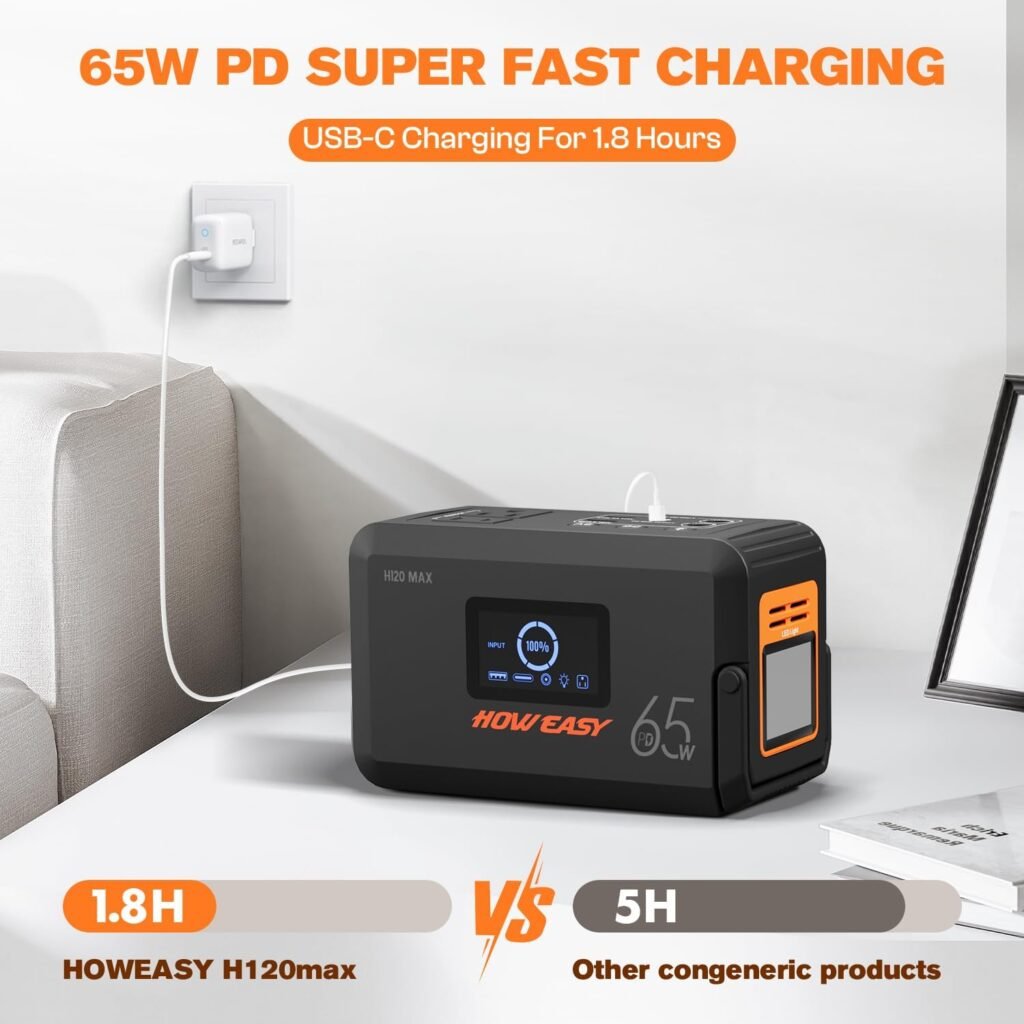
The 65W USB-C Power Delivery port is a major strength. It is not just for phones; it can charge many modern laptops efficiently. With compatible systems, we can get up to around 80% battery in about an hour, which aligns well with the manufacturer’s claims.
We can also use the PD port to recharge the power station itself, which is convenient for quick top-ups from a wall charger or another PD source. The dual role (input/output) means fewer cables and fewer ports to manage.
USB-A Ports and DC Outputs
The two USB-A ports handle our more traditional charging needs:
- The QC3.0 port provides fast charging for supporting phones and gadgets.
- The 5V/2.4A port is great for devices that do not need fast charge but benefit from a stable, higher-amp output.
The DC ports broaden the use cases even more. With the proper adapter cables, we can power some camping lights, certain types of fans, and other DC-compatible devices. These can be more efficient than AC for some gadgets, helping us stretch the 98Wh capacity further.
Charging the Power Station: Options and Speed
A portable power station is only as good as its ability to recharge efficiently. HOWEASY fortunately gives us several options, which matters when we are traveling or facing unreliable electricity.
Fast Charging with 65W PD
When we use a compatible 65W PD charger, we can bring the station up to about 80% in roughly an hour. That means we can plug it in during a lunch break, at a café, or at home before a trip and quickly get it ready for several more hours of device use.
This is particularly useful if we are using it during a long travel day: we can charge the station while charging our laptop, then lean on the station later when outlets are scarce.
Wall, Car, and Solar Charging
Beyond PD, the station supports:
- Wall adapter (included): We plug into a standard outlet and charge it like a traditional power bank.
- Car charger (included): We can top it off while driving, which is ideal for road trips, RV travel, or van life.
- Solar charging (15V–24V panels): With a compatible solar panel, we can turn this into a small off-grid power solution.
We should keep in mind that solar charging speeds depend heavily on panel wattage, sunlight conditions, and panel orientation. With a modest panel, the station can become a daily “power hub” for phones and small electronics when camping, as we replenish it during the day and use it at night.
LED Flashlight: More Than Just a Gimmick
Integrated flashlights often feel like throwaway add-ons, but in an emergency or camping situation, built-in lighting becomes genuinely useful. In this case, HOWEASY includes a multi-mode LED with four settings:
- Low
- Medium
- High
- SOS
Practical Uses for the 4 Modes
Low and medium brightness modes are great when we want to save battery while still seeing what we are doing, such as cooking by the tent or walking around a campsite. High mode is better for illuminating a larger area.
The SOS mode can be a real asset if we ever need to signal for help or alert others to our location. It may not be a feature we plan to use often, but when we need it, we are glad it is there.
Because the light draws relatively little power, we can often use it for long durations without significantly eating into the battery capacity needed for our devices.
Safety and Reliability: The Six-Fold BMS Protection
Battery safety and longevity matter a lot, especially with lithium cells. HOWEASY includes a Battery Management System (BMS) that monitors several critical conditions:
- Over-voltage protection
- Overload protection
- Over-current protection
- Overheating protection
- Short-circuit protection
- Overcharge protection
Why This Protection Matters for Us
Without a solid BMS, we risk damaging both the power station and whatever we plug into it. The six-fold protection reduces those risks in everyday use:
- If a device tries to pull too much power, the system can shut down output to protect itself.
- If temperatures climb too high (such as in a hot car), it can pause operation until conditions are safe.
- If we leave the station plugged in too long, overcharge protection helps reduce stress on the battery.
This also ties into durability in harsher environments. The unit is built to handle drops and temperature variation better than a typical consumer power bank, making it better suited to camping, workshops, and emergency use.
Real-World Scenarios: Where This Power Station Fits Best
To decide if this product matches our needs, it is helpful to think through situations where it would be most valuable and where it might fall short.
Camping and Outdoor Adventures
For short to medium camping trips, this fits wonderfully. We can:
- Keep phones, headlamps, and Bluetooth speakers charged.
- Use the AC outlet for occasional laptop use, camera battery charging, or small electronics.
- Rely on the integrated LED as a backup campsite light.
- Pair it with a solar panel for semi-off-grid use.
Because it is light and compact, it does not feel like a burden in our pack or car. For backpacking, we should note that 2.2 lbs may be more than we want to add to an ultralight setup, but for car camping or RV use, it feels just right.
Home Backup During Short Outages
While this is not a replacement for a large home backup system, it is excellent for brief blackouts. During a short outage, we can:
- Keep our phones charged and connected.
- Run a router or modem briefly (if power draw is within range) to keep internet up if our ISP infrastructure is still powered.
- Power a desk lamp or small LED light.
- Run small medical devices that have modest power needs, if they are compatible with the watt limits.
It is a great part of a larger emergency kit, especially in areas prone to storms or grid instability. We should just be mindful of expectations: it will not run high-draw appliances or support the whole home, but for essential electronics and communication, it does the job.
Travel and Remote Work
For those of us who work remotely and often find ourselves in airports, trains, or cafés with limited outlets, this station can be a lifesaver. We can:
- Charge our laptop via USB-C PD.
- Share power with colleagues using the other USB ports.
- Use the AC outlet for gear that lacks USB-C compatibility.
The airline-safe capacity makes it uniquely travel-friendly. We avoid the frustration of having our power station rejected at security checkpoints, provided we follow airline rules and keep it in carry-on luggage.
Photography, Drones, and Creative Work
If we are into photography or use drones, portable power becomes essential. This station can:
- Recharge multiple camera or drone batteries in the field.
- Power battery chargers that require AC outlets.
- Keep tablets or laptops charged so we can review and edit shots on-site.
The ability to charge seven devices simultaneously means we can top off batteries, phones, and tablets all at once instead of prioritizing them in sequence.
Usability: Everyday Experience and Workflow
Power specs are one thing; how the device feels in daily use is another. The HOWEASY unit is designed to be straightforward, which we appreciate when we are tired, working in the dark, or juggling multiple devices.
Controls and Indicators
The station typically includes:
- Clearly labeled ports
- Power buttons for AC and DC/USB outputs
- Battery level indicators (LEDs) to show remaining charge
This layout helps us quickly understand what is happening. We do not need to guess whether AC is on or off, and we can gauge whether we have enough remaining power to handle another laptop session or several phone charges.
Noise and Heat
Unlike gas generators, this power station is quiet. We might hear a faint fan noise if it needs to cool down under heavier load, but otherwise it should be nearly silent, which is perfect for quiet campsites, bedrooms, or shared working spaces.
As for heat, the BMS and internal design aim to keep it within reasonable operating temperatures. We should still avoid covering it with blankets or placing it in direct sun for long periods, as that will stress any battery-powered device.
Strengths and Limitations
To get a balanced view, it helps to summarize where this product stands out and where it naturally has limits.
What We Might Really Like
-
Lightweight and very portable
We can actually carry it without feeling weighed down, making it a realistic everyday companion. -
Airline-friendly capacity
Under 100Wh, it fits safely within most airline battery policies for carry-on luggage. -
65W PD fast charging
This raises it above many basic power banks by allowing serious laptop charging and fast recharge of the station itself. -
Multiple output options
AC outlets plus USB and DC means we can support a mix of legacy and modern devices at once. -
Built-in multi-mode LED
Adds real value for camping, night work, and emergencies, especially with SOS mode. -
Robust safety protections
The 6-fold BMS adds peace of mind, especially when charging valuable electronics. -
Flexible charging methods
Wall, car, PD, and solar options give us multiple ways to keep it topped up.
What We Should Keep in Mind
-
Not meant for heavy appliances
At 135W rated and 200W peak, it cannot handle devices like kettles, large fans, big monitors, or anything with high startup wattage. -
Limited capacity for continuous AC use
While 98Wh is solid for small electronics, continuous AC loads will drain the battery relatively quickly. It is better suited to intermittent AC use and extended USB/DC use. -
Solar panel not included
If we plan serious off-grid use, we need to budget for a compatible solar panel to unlock that functionality. -
Not a long-term home backup solution
For multi-day outages powering multiple rooms, we would need a larger-capacity model. This one is more of a personal emergency power source.
Tips to Get the Most Out of the HOWEASY Portable Power Station
With a few simple habits, we can stretch the performance and lifespan of this unit.
Use DC and USB When Possible
Whenever we can, we should power devices via USB or DC instead of AC. AC requires converting the battery’s DC power, which introduces some energy loss. USB and DC loads are generally more efficient, letting us squeeze more runtime out of the 98Wh capacity.
That might mean:
- Charging our laptop via USB-C PD instead of using the AC brick, if supported.
- Using USB-powered lights and fans rather than AC versions.
Check Device Wattage Before Plugging In
Before plugging in a new device, it is wise to:
- Look at the label on the device or charger for wattage or volts/amps.
- Ensure it stays within the 135W continuous rating and 200W peak.
This helps prevent tripping the protection system and ensures safe, predictable operation.
Maintain the Battery with Regular Charging
The manufacturer recommends charging every 1–2 months to keep the battery healthy when it is not in use. Lithium batteries do best when they are not left completely discharged or fully charged for extremely long periods.
We can pick a recurring day, like the first weekend of each month, to check and top up the station. This habit ensures it will be ready to go when we genuinely need it.
Store It Properly
Battery devices appreciate cool, dry storage locations away from direct sunlight. We should avoid leaving it for long periods in very hot or very cold conditions, such as a car trunk in summer or winter, as that can degrade battery life over time.
Who Is This Portable Power Station Best For?
Matching the product to the right user makes all the difference in satisfaction.
Ideal Users
We think this station is a strong match for:
- Casual campers and weekend adventurers who want convenient power for phones, lights, and occasional laptop use.
- Frequent travelers who need an airline-safe power backup with AC and USB ports.
- Remote workers and students who often work away from consistent outlets and want reliable laptop and phone charging.
- Content creators and photographers who carry multiple batteries and electronics into the field.
- Households building an emergency kit who want a compact, user-friendly backup for communication and lighting.
Less Ideal Users
Those of us looking to:
- Run high-draw appliances (coffee makers, microwaves, space heaters).
- Power multiple large devices for many hours continuously.
- Provide whole-room or whole-home backup for long outages.
would likely be better served by a larger-capacity power station with higher watt ratings and possibly expandable batteries. In that context, HOWEASY is more of a personal and portable solution than a full-scale emergency power source.
Comparing to a Typical High-Capacity Power Bank
A natural question we might ask is: why not simply buy a large USB power bank instead of a small power station like this?
Advantages Over a Standard Power Bank
- AC Outlets: We can plug in things that simply cannot run over USB, such as certain chargers, small AC devices, or specific accessories.
- Higher Wattage Outputs: 135W continuous output is well beyond most USB-only devices.
- Multiple Port Variety: USB-C, USB-A, DC, and AC all in one box.
- Integrated Lighting and Protection Systems: A more complete, multi-purpose power hub.
Where a Power Bank Still Wins
For ultralight travel or backpacking where every gram counts and we only need to charge phones and small USB devices, a simpler power bank can be lighter and sometimes cheaper. But the loss of AC and broader connectivity makes it less flexible in many situations.
In short, if we need AC and multi-device flexibility, the HOWEASY power station provides that bridge between an ordinary power bank and a heavy-duty generator.
Warranty, Support, and Long-Term Value
HOWEASY includes:
- A 24-month (2-year) product warranty
- 24/7 client service support
These aspects might not be top-of-mind when we unbox the product, but they matter in the long run. If we encounter any issues or have questions about compatibility, having responsive support and a decent warranty period adds peace of mind.
Considering the price bracket these portable stations typically sit in, a two-year warranty signals that the manufacturer expects the device to handle regular use without major problems.
Final Thoughts: Is the HOWEASY 98Wh Portable Power Station Worth It for Us?
When we sum everything up, this power station stands out as a compact, travel-friendly solution that offers:
- Enough capacity (98Wh) to comfortably support phones, tablets, cameras, and laptops for short to moderate periods.
- Genuine versatility with AC, USB-C PD, USB-A, and DC outputs, plus a built-in 4-mode LED light.
- Strong portability at just about 2.2 lbs with a compact footprint that fits easily into bags.
- Multiple ways to recharge, including wall, car, PD, and compatible solar inputs.
- Solid safety features with six-fold BMS protection for our devices and the battery.
It is not built to replace larger, high-capacity power stations for long outages or heavy appliances, but that is not what it claims to be. Instead, it shines as a personal, agile power companion for camping, travel, field work, and everyday backup.
If our priority is a friendly, easy-to-carry unit that can go from the campsite to the airport to our home office without fuss, while keeping up to seven devices powered at once, the HOWEASY 98Wh Portable Power Station fits that role very well.
Disclosure: As an Amazon Associate, I earn from qualifying purchases.
