Ad Blocker Detected
Our website is made possible by displaying online advertisements to our visitors. Please consider supporting us by disabling your ad blocker.
Have we ever wished we could carry a tiny, quiet, reliable power source in our hand, instead of hauling around bulky generators or hunting for wall outlets?

Why This Portable Power Station Caught Our Attention
We appreciate products that feel thoughtfully designed for real life, and this one instantly stands out. With its compact form, LiFePO4 battery, fast charging, and multiple ports, it fits the way we actually use our gadgets at home, on the road, and outdoors.
In this review, we share our impressions, break down the key features, and talk honestly about where this product shines and where it might not be the perfect fit.
Key Specifications at a Glance
We find it easier to understand a product when we can see the essential data lined up clearly. This battery station packs a lot into a very small body, so getting the basics in one place helps us see how it fits into our daily routines.
| Feature | Specification |
|---|---|
| Battery Type | LiFePO4 (Lithium Iron Phosphate) |
| Battery Capacity | 28,000 mAh / 89.6 Wh |
| Continuous Output Power | 100 W (pure sine wave) |
| Peak Output Power | 200 W |
| Dimensions | 6.5 x 3.2 x 4 inches |
| Weight | 2.5 lbs (approx. 1.13 kg) |
| AC Outputs | 2 x AC sockets (100 W, 200 W peak) |
| USB-C Outputs | 2 x USB-C (45 W and 15 W) |
| USB-A Outputs | 2 x USB-A (18 W and 15 W) |
| DC Output | 1 x DC5521 (60 W) |
| Charging Methods | AC fast charging, USB-C PD two-way, car charger, solar panel (not included) |
| Display | LED screen (status and remaining power) |
| Built-In Light | LED flashlight with 4 brightness levels + SOS mode |
| Battery Lifespan | > 3,500 charge cycles (LiFePO4) |
| Noise Level | Fanless, ultra-quiet design |
Design and Portability
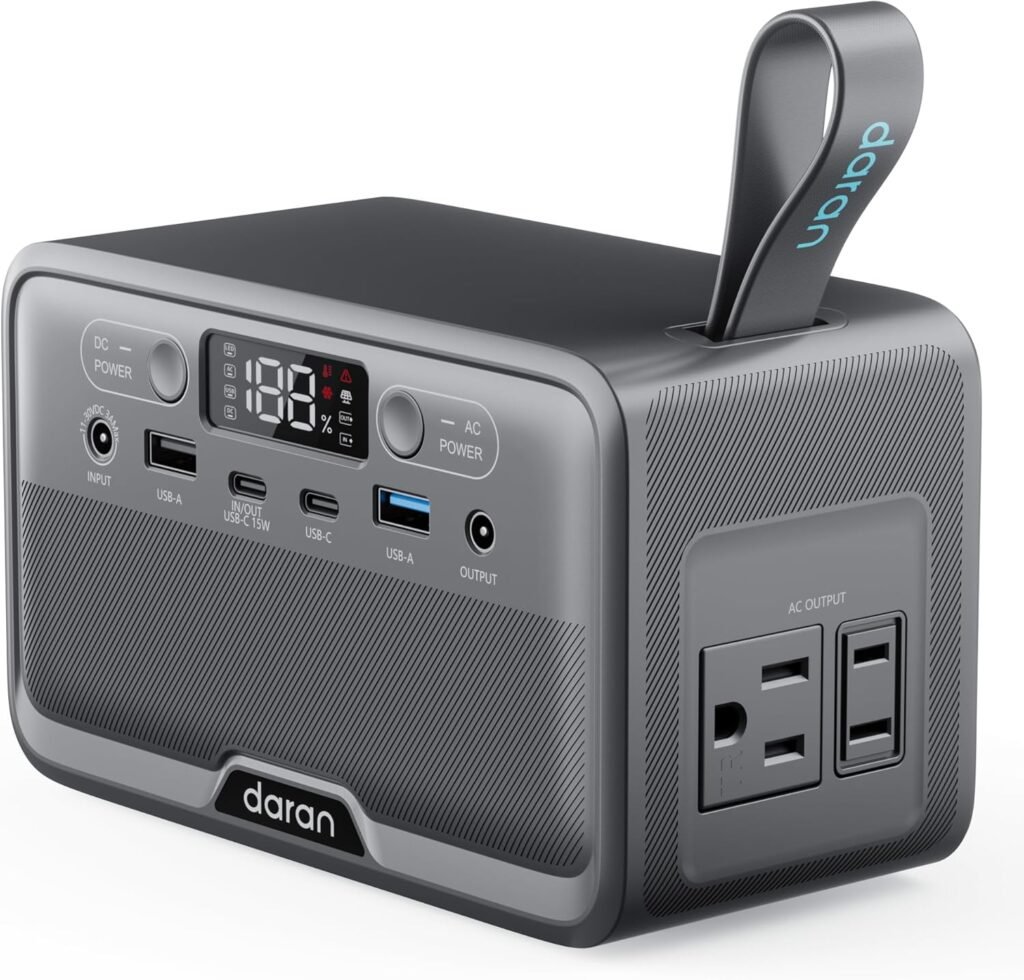
We tend to judge a “portable” gadget first on whether we would actually carry it around. In this case, the answer is yes. The combination of compact size and smart handle design makes a real difference.
Ultra-Compact Form Factor
This power station is closer in footprint to a large smartphone than a traditional generator. At 6.5 x 3.2 x 4 inches, it fits easily in a backpack, messenger bag, or even a large jacket pocket.
We like that we do not have to dedicate a whole bag just for the power station. It slips beside a laptop, tablet, or camera gear without becoming a burden.
Lightweight But Solid
At just 2.5 pounds, we find it light enough to carry all day without fatigue, yet heavy enough to feel sturdy and well-built. It does not feel flimsy, and that is important when we are tossing it into a backpack, car trunk, or luggage.
We also appreciate the highly integrated molding design, which contributes to durability and reduces the number of external seams or weak points.
Ergonomic Handle for Everyday Use
The soft, ergonomic handle feels like more than a cosmetic detail. We notice it when we grab the unit quickly to move around the house during a power outage, or when we carry it around a campsite.
Instead of awkward edges digging into our fingers, the handle gives us a secure and comfortable grip, which is surprisingly helpful when our hands are full of other gear.
Battery Technology and Capacity
Battery chemistry matters a lot for both safety and longevity. Here, the use of LiFePO4 stands out compared with many small power banks that still rely on older chemistries.
Why LiFePO4 Matters
LiFePO4 (Lithium Iron Phosphate) batteries offer several advantages over typical lithium-ion or NCM (nickel-cobalt-manganese) batteries:
- Better thermal stability and safety
- Longer cycle life (more charge and discharge cycles)
- More consistent performance over time
We value that this station uses LiFePO4 because it makes us more comfortable using it indoors, around kids, and over long periods.
28,000 mAh / 89.6 Wh: What That Really Means
Numbers can be abstract, so we like to translate them into real-world usage. While actual results vary by device and conditions, we can expect approximate usage like:
- Smartphones: multiple full charges (often 5–8 depending on battery size)
- Tablets: several full charges
- Laptops (lower-power or USB-C laptops): up to 1–2 charges
- Small appliances under 100 W: several hours of operation
We find that 89.6 Wh is a sweet spot for flight-friendly capacity in some regions and still enough to run meaningful loads during short trips or brief blackouts. Of course, we always check airline rules before flying.

Power Output and Device Compatibility
For us, a portable power station needs to be more than a big battery. It needs to power the variety of devices we rely on daily, from phones to small household items.
100 W Continuous, 200 W Peak Power
The pure sine wave output at 100 W continuous and 200 W peak allows us to run or charge sensitive electronics safely. That pure sine wave output is closer to the power we get from wall outlets and is friendlier to devices like:
- Laptops
- Monitors (low-power)
- Routers and modems
- CPAP machines (low wattage models, check device specs)
- Camera battery chargers
The 200 W peak helps handle brief surges when certain devices start up, though we still keep an eye on each device’s rated power needs.
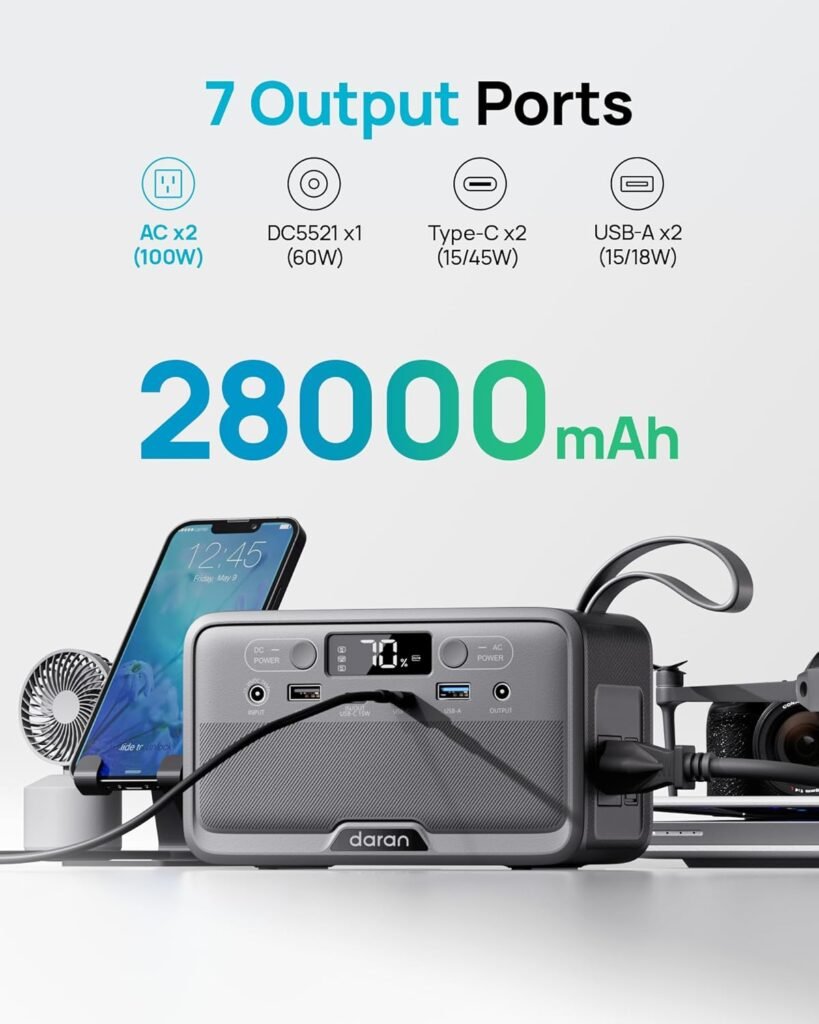
Seven Output Ports for Multi-Device Use
We appreciate that we can power several devices at once. Instead of juggling multiple power banks, we use one compact power center.
AC Outlets
The 2 AC sockets are what make this unit feel like a mini power station rather than just a power bank.
- 2 x AC outlets at up to 100 W continuous (shared)
- Ideal for laptop chargers, mini fans, small lamps, routers, or low-power electronics
We like the flexibility of plugging in existing chargers without having to buy special cables.
USB-C Ports
The presence of 2 USB-C ports, including a 45 W port, is extremely practical.
- 1 x USB-C (up to 45 W) for laptops, tablets, or fast-charging phones
- 1 x USB-C (approx. 15 W) for phones, Bluetooth speakers, earbuds, or smaller devices
We often use the 45 W port for USB-C laptops or tablets while the other USB-C handles a phone or accessory.
USB-A Ports
Even as USB-C becomes standard, we still have many devices and cables that rely on USB-A. The station includes:
- 1 x USB-A up to 18 W (fast charge)
- 1 x USB-A around 15 W
These are useful for action cameras, smartwatches, older phones, e-readers, or any USB-powered gadget we still use daily.
DC5521 Output
The DC5521 (60 W) output gives us another layer of flexibility:
- Great for certain LED lights, routers, or DC-powered devices
- Useful for hobby equipment or camping gadgets with barrel connectors
We appreciate having this port because it broadens compatibility beyond standard USB and AC devices.
Charging the Power Station
We care a lot about how fast we can recharge a power station, especially when we are short on time or dealing with an emergency. This unit stands out for its fast charging capabilities.
Ultra-Fast Recharging from 0 to 80%
Using its fast charging technology, the station can reportedly recharge from 0% to 80% in about 1.5 hours. That is quite fast for a device of this capacity.
We find this especially useful when:
- We have a short window of grid power during an outage
- We are packing and realize the unit is low on charge
- We are in a hotel, café, or office and want to top up quickly
Fast recharging means we get more usable runtime per day with less waiting.
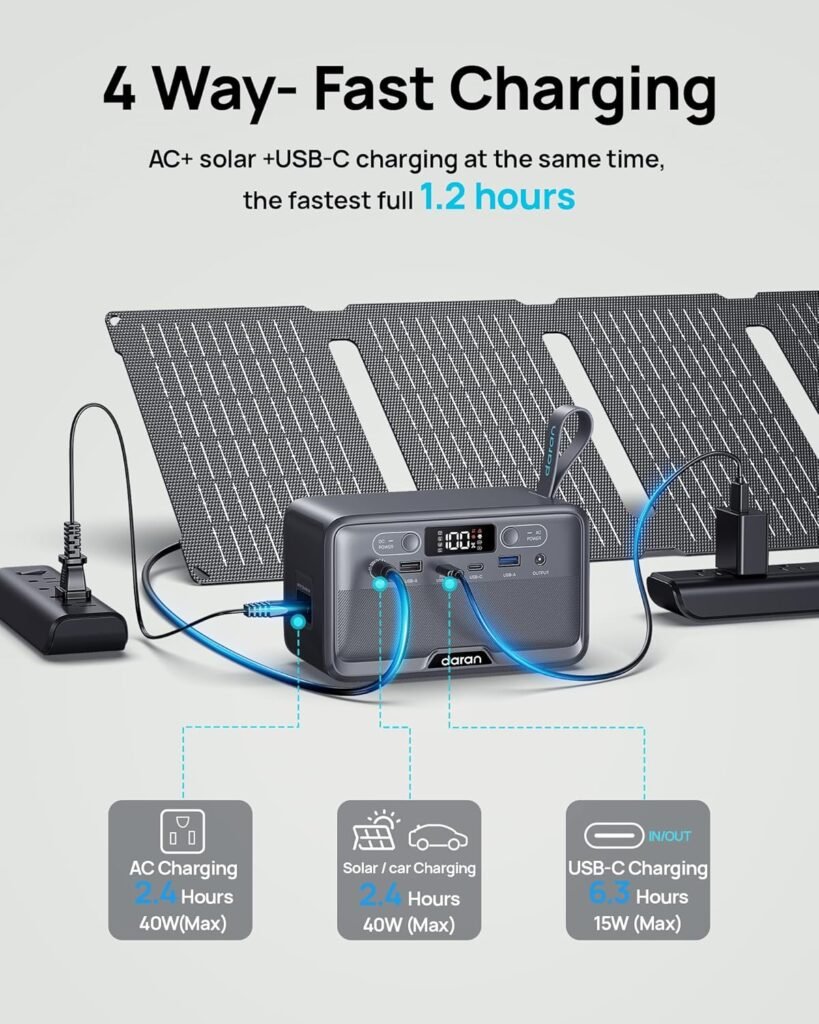
Four Charging Methods for Flexibility
We value backup systems that can adapt to different situations, and this station’s four charging options give us that flexibility.
1. AC Wall Outlet (Fast Charge)
This is the most straightforward method:
- Plug into a standard wall outlet and reach 0–80% in about 1.5 hours
- Ideal for home, office, or hotel use
We often use this as the main way to recharge before trips or during normal days.
2. USB-C PD Two-Way Fast Charging
The USB-C PD port supports two-way fast charging, which means:
- We can charge the station through USB-C
- We can also use the same port to charge other devices from the station
In some cases, AC and DC/USB-C inputs can be combined to speed up charging even more. We like that we can use a powerful USB-C adapter we already own instead of relying only on the included charger.
3. Car Charging
We find car charging especially helpful during road trips, van life, or when we are out on long drives:
- Plug into a 12 V car socket to recharge while on the road
- Great for topping up between campsites or during long commutes
We appreciate knowing that as long as the car runs, we can keep the station topped up.
4. Solar Panel Charging
Even though panels are not included, the station works with compatible solar panels:
- Charge via solar for true off-grid capability
- Useful during extended camping, overlanding, or long power outages
We like having the option to pair it with a solar panel later, turning it into a highly portable solar generator.
Safety, Durability, and Battery Management
We always look for safety protections, especially when a device is charging and discharging frequently in different environments.
Built-In BMS and 12 Safety Functions
The advanced Battery Management System (BMS) monitors key parameters like:
- Voltage
- Current
- Temperature
With 12 safety functions, we gain protection from common problems such as:
- Over-voltage and under-voltage
- Over-current and short circuit
- Overheating or low temperature conditions
This system helps protect both the power station and our devices, extending overall lifespan and making use more reassuring.
Over 3,500 Charge Cycles
LiFePO4 chemistry is known for longevity, and this unit leverages that strength:
- Rated for more than 3,500 charge cycles
- In practical terms, this can mean several years of frequent use
We see this as a longer-term investment rather than a disposable gadget. Over time, the cost per use drops significantly compared to standard power banks.
Quiet, Fanless Operation
Noise is a big factor for us when we use a power station indoors or at night. Many units rely on fans that spin up loudly under load. This product takes a different path.
Fanless Design for Silent Use
By using a fanless design and high integration, the station can operate very quietly:
- No constant fan noise in a bedroom or living room
- No distracting whirring in a camper or tent at night
We appreciate that we can keep it charging near us without being irritated by sound.
Ideal for Nighttime and Work Environments
Quiet operation becomes especially valuable when:
- We charge phones, tablets, or a laptop while sleeping
- We power small devices during late-night work sessions
- We rely on it in a shared space, such as a study area or office
We find that the almost silent performance makes it more likely we will use the station often, not just in emergencies.
LED Display and User Interface
We like having clear feedback about battery status and usage, especially when juggling multiple devices.
Easy-to-Read LED Screen
The LED display shows key information such as:
- Remaining battery percentage or level
- Operating status
- Possibly input/output indicators (depending on exact firmware)
We find this helpful when planning how long we can run devices or when to recharge. It reduces guesswork and helps prevent unexpected shutdowns.
Simple Controls and Layout
The ports and buttons are arranged in a user-friendly way:
- Clearly labeled output sections (AC, USB, DC)
- Intuitive power and LED light controls
We appreciate that we do not need to constantly check a manual. After using it a couple of times, the interface feels natural.
Built-In Emergency LED Light
We love when a power station doubles as a light source, especially during outages or camping.
Multi-Level Brightness Settings
The integrated LED flashlight offers four brightness levels:
- Low, for close-range use or preserving battery
- Medium, for general tasks
- High, for brighter illumination
- Extra-bright, for wide-area lighting or emergency use
We find this particularly handy in tents, cabins, or dark hallways at home.
SOS Mode for Emergencies
In addition to steady light modes, the flashlight includes an SOS function:
- Long press to turn the light on (to avoid accidental activation)
- Cycling through modes includes SOS signaling
We see this as a thoughtful safety feature. Whether we are lost, stranded, or simply trying to draw attention, the SOS mode can be reassuring.
Real-World Use Cases
We like to think in terms of scenarios rather than just specifications. Here are some ways we imagine and use this power station in everyday life.
At Home During Power Outages
During blackouts, this station can:
- Keep phones and tablets charged so we stay connected
- Power a low-wattage router and modem for internet access
- Run small LED lights or a mini fan for comfort
We might not run large appliances, but we can keep essential communication and lighting going without noise or fumes.
Camping and Outdoor Adventures
On camping trips, we appreciate:
- Charging phones, cameras, drones, GPS devices, and action cameras
- Running small LED lanterns or a portable fan in the tent
- Topping up a tablet or e-reader for reading at night
The light weight and compact size mean we actually take it along, instead of leaving it behind.
Road Trips and Van Life
In cars or vans, this unit becomes a versatile accessory:
- Charging devices while parked, without draining the car battery directly
- Running a laptop during remote work stops
- Powering mini projectors, speakers, and other entertainment gadgets
We like that we can recharge it from the car while driving, then use it independently when parked.
Everyday Use Around the House
Even when the grid is fine, we find it convenient to:
- Use it as a central charging hub in living rooms or bedrooms
- Move from room to room while keeping a laptop or tablet powered
- Avoid stretching cables to far-away outlets
It turns into a more flexible extension of our home power network.
Strengths and Limitations
No product is perfect for every situation, so we want to be clear about where this power station excels and where it might fall short.
What We Think It Does Especially Well
We see several standout advantages:
- Extreme Portability: Truly compact and light enough to carry every day.
- LiFePO4 Battery: Safer, longer-lasting battery chemistry with a long cycle life.
- Fast Charging: The ability to go from 0 to 80% in about 1.5 hours is very convenient.
- Quiet Operation: Fanless design makes it comfortable to use indoors and at night.
- Flexible Outputs: AC, USB-C, USB-A, and DC ports support a wide range of devices.
- Multiple Charging Options: Wall, USB-C PD, car, and solar charging for varied scenarios.
- Built-In Light with SOS: Useful for camping and emergencies, reducing the need for a separate flashlight.
We see it as an excellent portable solution for light-to-moderate power needs.
Where It May Not Be the Best Fit
We also want to acknowledge practical limits:
- 100 W Output Ceiling: It cannot safely handle medium to high-power appliances like kettles, hair dryers, microwaves, or many power tools.
- Limited Capacity for Long-Term Off-Grid Living: While fine for short trips and weekend camping, 89.6 Wh is modest for extended off-grid living without frequent recharging or large solar setups.
- Solar Panel Not Included: We need to purchase compatible panels separately if we want solar charging.
- Not for Heavy Medical Equipment: We would not rely on it for high-demand life-support medical gear without explicit confirmation from the device manufacturer.
We view it as a “pocket generator” for electronics, not a full household backup system.
Comparison with Traditional Generators and Power Banks
We find it helpful to understand what niche this product fills compared with other common solutions.
Versus Traditional Gas Generators
Compared to gas generators, this station offers:
- No fumes or emissions
- Virtually silent operation
- Much smaller and lighter footprint
- Safe for indoor use
Of course, it cannot match large generators for total power output or long-duration appliance support. We see it as complementary: ideal for personal electronics, not whole homes.
Versus Standard Power Banks
Against regular power banks, this unit stands out because:
- It provides AC outlets, not just USB ports
- It uses safer, longer-life LiFePO4 cells
- It has higher total capacity in a compact format
- It includes a multi-mode LED light and more robust protections
For us, it sits between a simple power bank and a full-sized portable power station, combining the portability of the former with many of the features of the latter.
Gift Potential and Everyday Value
We often look for gifts that are both thoughtful and genuinely useful. This portable power station fits that description for many people in our lives.
A Practical Gift for Tech-Lovers and Travelers
We see this as an excellent gift for:
- Campers, hikers, and outdoor enthusiasts
- Digital nomads and frequent travelers
- College students in dorms with limited outlet access
- Parents who want reliable backup power for small devices
Because we all use phones, tablets, and laptops, a compact power source quickly becomes part of everyday life.
Suitable for Many Occasions
The product description highlights its suitability for many gifting occasions:
- Birthdays
- Christmas
- Valentine’s Day
- Mother’s Day and Father’s Day
- Graduation gifts
- Housewarming or “new apartment” presents
We like that it works as a unisex, age-flexible tech gift that does not feel gimmicky.
Tips for Getting the Most Out of This Power Station
We have noticed a few habits and practices that help us use such a device more effectively and prolong its life.
Plan Device Loads Wisely
We try to:
- Prioritize essential devices (phone, router, laptop) during outages
- Check power ratings on any AC devices before plugging in
- Avoid overloading the 100 W limit to keep the unit safe and efficient
This ensures we get the most runtime and avoid tripping protections.
Maintain Battery Health
To extend lifespan, we:
- Avoid storing it at 0% for long periods
- Recharge it periodically if unused for months
- Keep it away from extreme temperatures (very hot cars or freezing environments)
With LiFePO4 and good habits, we expect a long service life.
Keep It Charged and Accessible
We like to:
- Store it somewhere easy to reach in emergencies
- Keep it partially or fully charged during storm seasons
- Pair it with a small solar panel if we use it frequently off-grid
That way, we are always ready for both planned trips and unexpected outages.
Customer Support and Satisfaction
The product description emphasizes a commitment to customer satisfaction. While we always judge support based on experience, we appreciate that the seller clearly invites users to reach out if problems occur.
We see that as a good sign that they stand behind the product. Being able to get help with usage questions or potential issues makes us more comfortable relying on a power station in critical moments.
Our Overall Impression
We see the Portable Power Station 28,000 mAh / 89.6 Wh LiFePO4 100 W Battery (200 W Peak) as a smart, compact solution for people who want reliable, quiet power on the go or at home for small devices.
Its strongest points, in our view, are:
- Truly portable size and weight
- Safe, long-lasting LiFePO4 battery
- Fast recharging and multiple charging methods
- Quiet, fanless design suitable for bedrooms and shared spaces
- Useful mix of AC, USB-C, USB-A, and DC outputs
- Integrated multi-mode LED light with SOS function
It is not meant to run heavy appliances or sustain an entire household off-grid. Instead, it excels at powering the devices we care about most: phones, tablets, laptops, small electronics, and modest household gear.
If we are looking for a pocket-sized, quiet, and dependable power companion for everyday convenience, short trips, and emergency backup of small devices, this portable power station offers a well-balanced blend of practicality, portability, and modern battery technology.
Disclosure: As an Amazon Associate, I earn from qualifying purchases.